|
|
|
|
|
|
|
|
|
Oberleutnant Gunther Seeger Signed Naval Art
 | Ace with 56.00 Victories |

 |
| Knights Cross |
| Oberleutnant Gunther Seeger - Signed Naval Art Naval Crew Signatures |
|
|
|
|
|
|
|
|
|
|
|
|
|
|
|
|
|
|
|
|
| Text for the above items : |
The Battle for Britain by Robert Taylor. A Battle of Britain Spitfire from 610 Squadron takes on a Me109 from I./JG3 in a head-on attack high over the south coast port of Dover, in the late morning of 10 July 1940. |
Special Duties by Robert Taylor. A Junkers Ju52 of Luftflotte 2, escorted by Me109s of JG-53, transports important military personnel over the Dolomites in 1942. With the setting sun illuminating the mountain tops in a brilliant light, the panoramic vista is both chilling and spectacular. As the aircraft lumbers across the impressive mountain scenery, members of the High Command can be seen in conference in the cabin, while crew in the cockpit concentrate on their special duties flight plan. Behind them, unprotected from the elements, a lone gunner keeps a watchful eye. The Ju52 became the Luftwaffes primary wartime transport aircraft, taking part in every German army land operation during World War II. |
Assault on the Capital by Robert Taylor Robert Taylors final painting in his 60th Anniversary trilogy features a scene from the attacks on the afternoon of September 7, 1940. Led by Herbert Ihlefeld, Me109Es of II/LG 2 dive through the bomber formation giving chase to Hurricanes of 242 Squadron as Ju88s of KG30, having unloaded their bombs, head for home. One Ju88 has been hit and is already losing height, and will not return. Following behind He111s of KG53 try to keep formation as they fly through flak. The sky is alive with action. |
Head on Pass by David Pentland. St Nazaire, France, 1st January 1943. Leading the Focke Wulf 190s of III Gruppe, Jagdgeswader 2, Gruppenkommandeur Egon Mayer, cut a swathe through the attacking waves of US Eigth Airforce B17s. The recently developed tactic of the head on pass was proving successful against the daylight heavy bombers, with Mayer claiming 2 for himself in this engagement. |
Stabsschwarm by David Pentland. Etaples, Northern France, 13th October 1941. Me109F-4s of Stabsschwarm JG2, flown by Geschwaderkommodore Major Walter Oesau, Oberleutnant Erich Leie, Oberleutnant Rudolf Rudi Pflanz, and Gefreiter Gunther Hupatz Seeger. Each was a notable ace in his own right but together they were a formidable combination. On this sortie alone they accounted for 5 RAF Spitfires. |
Open Assault by Robert Taylor. The Junkers Ju87 Sturzkampfbomber, known to the British simply as the Stuka, had already acquired a deadly reputation across Europe, its siren screaming as the ungainly dive-bomber struck terror into the hearts of those below. In 1940 its pilots crossed the Channel with their grim-looking aircraft to terrorise the southern towns and ports of England. Robert Taylors painting Open Assault, depicts Hurricanes of 501 Squadron attacking a force of Ju87 Stukas as they dive-bomb naval vessels and installations in the port of Dover on 29 July 1940. High explosive bombs detonate within the sheltered anchorage as escorting Bf109s from JG51 race in to protect their lumbering charges. Four Stukas and two Me109s are despatched, for the loss of just one RAF aircraft. |
Messerschmitt Country by Nicolas Trudgian Nobody, least of all Allied aircrew, ever doubted the tenacity of the Luftwaffe, more particularly that of the German fighter pilots. From the early encounters during the Battle of Britain to the greeat air battles in defence of their homeland late in the war, at all times they were held in high regard, even if resented as a foe. At no time was their dedication, determination, and courage better demonstrated than during the final stages of World War Two. By the summer of 1944 the Allies had gained a foothold in Normandy, and total air superiority above northern France. German installations and ground positions were being pounded daily from the air, and the Ruhr, the heartland of industrial Germany, was under constant siege. Even the factories in southern Germany were not safe from the attentions of the USAAF bombers by day, and the RAF by night. But in spite of the pressures of mounting losses and diminished supplies, the Luftwaffe fought doggedly on in best traditions of the fighter pilot. The morning of 19th July 1944 saw the USAAFs 8th and 15th Air Forces mount an attack of awesome proportion against the aircraft factories in the region of Munich. To combat a seemingly overwhelming force of 1400 bombers and almost as many fighter escorts, the Luftwaffe were able to put up just three Gruppen from JG300 and one from JG302, flying a mix of Me109Gs and Fw190s - barely 50 serviceable fighters between them. They were joined by a dozen Me109s of II./JG27, these fighters desperately trying to defend the very factories in which they were made. |
Valiant Response by Robert Taylor. The Spitfires of 54 Squadron, quickly scrambled from nearby Hornchurch, clash with the Me109s from 1./JG51 over Kent. Below, Me110s from KPRG210 are about to receive unwelcome attention as the rest of the Spitfires hurtle down upon them and in the distance, a group of Hurricanes rip through a dense formation of Do17s from KG76 as they struggle back to France. What clouds there are will be unlikely to give much sanctuary and, for the onlookers on the ground far below, the skies will soon be filled with weaving trails of smoke and debris. For nearly a week the Luftwaffe had thrown everything they had into the attack on southern England in order to annihilate RAF Fighter Command, in preparation for Operation Sealion, the invasion of Britain. And, heavily outnumbered, the young RAF Spitfire and Hurricane pilots of Fighter Command had so far repelled them, at a cost. But on Sunday 18 August 1940, the Germans launched the heaviest formations of aircraft seen in the battle so far. This was to be a grinding day of relentless assaults on the airfields of southern England, the hardest day of the Battle of Britain. |
Achtung - Indianer, Rechts by Iain Wyllie. Leutnant Julius Maimberg in Messerschmitt Me109E white 11 and his Katschmarek Unteroffixzier Rudolf Miese of 4 Staffel, JG2 Richthofen turn towards a distant squadron of RAF fighters during the Battle of Britain. |
Bf109E of III./JG2 - Summer 1940 by Ivan Berryman. A Bf109E fighter is prepared to fight over southern England during the Battle of Britain. |
No Escape by David Pentland. Bf109 G2 of Major Gunther Rall pursues and downs an unidentified Soviet aircraft over the Caucasus, Russia, early Autumn 1943. Rall went on to become the third highest scoring ace of all time, with 275 victories in only 621 missions. |
Eagles on the Channel Front by Robert Taylor. An exceptional painting by the worlds foremost aviation artist remembering the most famous of all Luftwaffe Fighter Wings that fought on the Western Front during the early years of World War Two. Prints are signed by Luftwaffe Aces who contested the great air battles with pilots of the RAF on the infamous Channel Front, 1940-1941 Badly mauled during the Battle of Britain, by early 1941 the Luftwaffe fighter wings, strung right across northern France, were back on strength. The front line squadrons were reequipping with the up-rated Me109F and, though suffering initial over-heating problems, the remarkable new Fw190A was making its first appearances. The Luftwaffe pilots were again full of confidence, and having the air endurance advantage of fighting close to their bases, they were competing on equal terms with the Spitfires and Hurricanes of RAF Fighter Command. Having spent the first 18 months of the war fighting a defensive air battle, RAF Fighter Command was raring to go onto the attack. The mix of Rhubarbs - two or three-plane, low-level incursions to attack enemy bases and installations - and large fighter sweeps aimed to entice the Luftwaffe up for a fight, kept the German fighter pilots busy throughout the summer. All through 1941 great air battles raged all along the Channel Front. Robert Taylors comprehensive work Eagles on the Channel Front, the fourth and final print in his widely acclaimed Wings of the Luftwaffe series, recreates a scene in northern France in the late autumn of 1941. Having just returned to their temporary airstrip in the region of St. Omer, Luftwaffe pilots of JG-26 excitedly debrief their recent encounter with Spitfires and Hurricanes, fought high over the Channel coast. The gleaming new Me109Fs are discreetly parked under trees on the edge the airfield, providing some cover from low-level surprise attacks. While ground crews busily prepare the Wings Me109s for another mission, a group of the exciting new Fw190A fighters taxi out. The scenario will continue right into winter. In his inimitable style, and with inordinate skill, Robert Taylor manages to evoke the heady atmosphere of a German front line airfield on the Channel Front in 1941. |
First Combat by David Pentland. Franco-German border, 22md November 1939. While flying a routine border Frei Jagd for some reconnaissance Dorniers, eight Me109s of 3./JG2 were engaged by fourteen French Curtiss Hawks of GC II/4. During the ensuing dogfight, the first combat for the Richthofen Geschwader since WW1, two of the French fighters were shot down. The first by Lt Helmut Wick, was flown by the French ace Adjutant Camille Plubeau (14 victories) the other by Ofw Erwin Kley. Wick was to go on to become one of the great aces of the Battle of Britain, achieving 56 victories before his death in November 1940. |
Stormclouds Gather by Nicolas Trudgian Me109s of I/JG2, under the command of the brilliant Helmut Wick, setting out on a mission across the English Channel in September 1940. Wick, seen in the foreground, with Gunther Seeger off his starboard wing, was the top-scoring Luftwaffe Ace in the Battle of Britain with 56 victories. Published 2000. |
Clipped Signature - Gunther Seeger. A Knight's Cross winning Luftwaffe Me109 Ace with over 50 victories. He died in 2013. |
The Last Eagle, Innsbruck, Austria, May 1945 by David Pentland. Abandoned Me 109G-10, 3rd Staffel JG4. |
High Pursuit by Ivan Berryman. Squadron Leader H C Sawyer is depicted here flying his 65 Sqn Spitfire Mk.1a R6799 (YT-D) in the skies above Kent on 31st July 1940 at the height of the Battle of Britain. Chasing him is Major Hans Trubenbach of 1 Gruppe, Lehrgeschwader 2 in his Messerschmitt Vf109E-3 (Red 12) . The encounter lasted eight minutes with both pilots surviving. |
Dawn Eagles Rising by Robert Taylor. September 1940: The Battle of Britain reaches a crescendo as Me109s of the 1./JG52, their bright yellow noses glinting in the sun, gather speed and altitude as they form up after take-off from their base at Coquelles, near Calais. Led by Hauptmann Wolfgang Ewald, the Scharwm settle into their loose, finger-four formation, the pilots alert for danger and ready for yet another raid on England, just a few miles across the Channel. |
Horrido! by Robert Taylor. Of the many outstanding Luftwaffe fighter Wings of World War II, JG52 became the most successful. Many of the most famous Aces flew with this legendary wing, including one-time Squadron Commander Adolf Galland. JG-52 was home to the only fighter Aces in history to destroy more than 300 enemy aircraft - Erich Hartmann and Gerhard Barkhorn. The wings top ten scoring Aces amassed a staggering 2286 aerial victories and, by the end of the war, JG-52s pilots had recorded over 10,000 aerial victories; sixty-seven of their number were awarded the coveted Knights Cross or higher decorations, but the cost to the Wing was high: 678 of its aircrew perished in combat, while many others were taken prisoner following combat. Appropriately, Robert Taylor has chosen the Me109s of JG52 as his subject to represent the fighter pilots of the Luftwaffe in his tribute to these courageous flyers, with his breathtaking painting Horrido! With the traditional battle cry ringing in their ears, Squadron Commander Hptm Wolfgang Ewald leads pilots of I./JG52 into combat. Based at Coquelles/Calais in September 1940, the JG-52 Me109s hurtle down in a high-speed dive to engage the enemy during the ferociously fought Battle of Britain. Robert eloquently depicts these sleek and deadly fighters high over the Channel, glinting and menacing against an ominous backdrop of heavy cumulous clouds. |
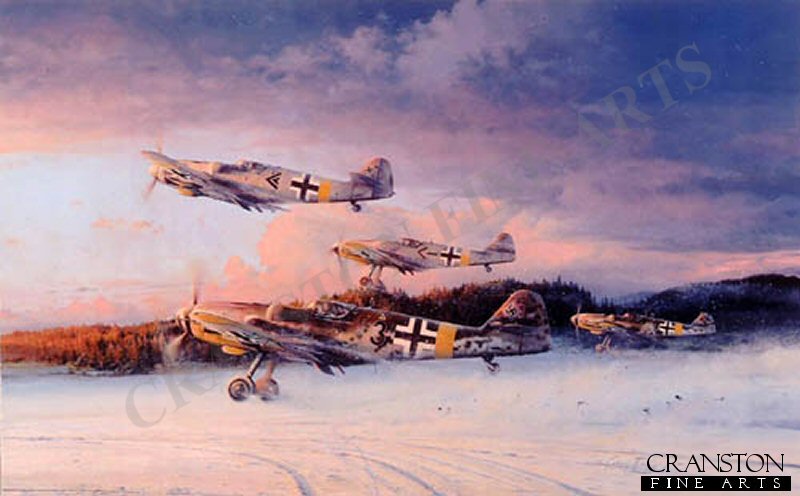
Eagles at Dawn by Robert Taylor. On Thursday, August 24, 1944 a 22-year old Oberleutnant Erich Hartmann powered his Mel09G fighter in a spectacular low pass over his squadrons airstrip in north-eastern Rumania, wagging his wings to the cheering Luftwaffe personnel on the ground below. The young flaxen-haired pilot had just become the first fighter Ace in history to bring down 300 enemy aircraft in combat. As World War II drew to its close, after three and a half years of continual aerial combat, this gifted young fighter pilot brought his final tally of aerial victories to 352, bringing down a Yak-7 during the last of his 1400 missions on May 8, 1945. He was the most successful fighter pilot of all time. In this dramatic rendition, we see captured a brilliantly colourful midwinter scene during the final phase of the war on the Eastern Front. Glinting in the sub-zero early morning sunlight as fresh snow begins to fall, and led by their Gruppenkommandeur Erich Hartmann, the Mel09G fighters of I./JG-53 scramble off the snow-covered airstrip at Veszprem in Hungary, February 1945. They will intercept waves of Russian fighters and bombers in the skies above Czechoslovakia in a last ditch attempt to repel the impending invasion of Germany. |
|
Contact Details |
|
Sign Up To Our Newsletter!
This website is owned by Cranston Fine Arts. Torwood House, Torwoodhill Road, Rhu, Helensburgh, Scotland, G848LE Contact: Tel: (+44) (0) 1436 820269. Email: cranstonorders -at- outlook.com
|
 |