|
|
|
|
|
|
|
|
|
Wing Commander John Freeborn DFC* Signed Naval Art
 | Ace with 13.50 Victories |

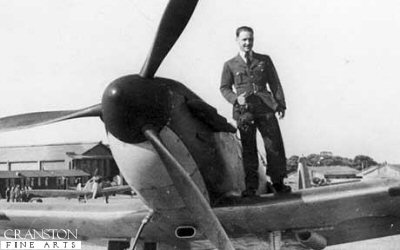
John Freeborn standing on his aircraft
|
| ||
John Freeborn with Bob Yeoman. |
John Freeborn with Cranston Fine Arts owner David Higgins. |
Cranston Fine Arts would like to thank Bob Yeoman for his help in carrying out this signing session with John Freeborn, and of course John Freeborn himself for taking the day (28/2/2010) to sign our art prints.
 | |
| Distinguished Flying Cross | Bar to the Distinguished Flying Cross |
| Wing Commander John Freeborn DFC* - Signed Naval Art Naval Crew Signatures |
|
|
|
|
|
|
|
|
|
|
|
|
|
|
|
|
|
|
|
|
|
| Text for the above items : |
Spitfire Alley by Ivan Berryman. A pair of Spitfire Mk.IXs of 402 Squadron Royal Canadian Air Force, based at Kenley, practise combat manoeuvres in the skies above Kent in May, 1943. |
Spitfire Mk.IXE by Ivan Berryman. A pair of Spitfire Mk.IXEs of 611 Squadron make their way home from a patrol during the summer of 1942. At this time 611 Squadron were based at Kenley and were the first squadron to receive the new Mk.IX putting it on equal terms, for the first time, with the formidable Focke-Wulf 190. |
The Hunting Party by Ivan Berryman. Depicting Spitfires of No.92 Squadron, which on their first mission over Dunkirk, encountered six ME109Es and succeeded in shooting down every one of them! Such actions came to symbolise the spirit of the 92nd Squadron which went on to see intense fighting during the Battle of Britain and by the end of 1940 had claimed an astonishing 127 enemy aircraft destroyed. A dramatic and unusual perspective on this classic aeroplane addition to any collection of Spitfire paintings. |
Close Combat by Ivan Berryman. Whilst flying with A Flight of 85 Squadron on 30th July 1940, Geoffrey Allard encountered a pair of Messerschmitt Bf.110s about 40 miles from the coast, apparently patrolling near a convoy. After Squadron Leader Townsend, flying Red 1, had made two unsuccessful attacks, Allard closed to 150 yards and began to fire continuously, eventually closing to just 25 yards, whereupon the starboard engine of the Bf.110 began to disintegrate. This was just one of eight victories that Allard claimed during the Battle of Britain to add to a previous eight that he had scored flying Hurricanes during the Battle of France. |
Victory Above Dover by Ivan Berryman. Adolf Galland claimed his 16th victory on the afternoon of 25th July 1940 when Spitfires of 54 Sqn were bounced by Messerschmitt Bf.109s of Gallands III/JG26. A fierce battle ensued off Dover during which F/Lt Basil Wonky Way, flying R6707, found himself the subject of the great German aces attention, his stricken aircraft being observed to plunge into the sea after receiving numerous hits from the Bf.109s guns. F/Lt Way lost his life in the crash, presumed drowned. |
Close Encounter by Ivan Berryman. Supermarine Spitfire Mk.1As of No.610 (County of Chester) Sqn RAAF, intercept incoming Heinkel 111H-16s of the 9th Staffel, Kampfgeschwader 53 Legion Condor during the big daylight raids on London of August and September 1940 - the climax of the Battle of Britain. Spitfire N3029 (DW-K) was shot down by a Bf109 on the 5th of September 1940 and crash-landed near Gravesend, Kent, thankfully without injury to Sgt Willcocks, the pilot. For the record, N3029 was rebuilt and, following some brief flying in the UK, was sent overseas by convoy to the Middle East. Ironically, the ship carrying this aircraft was torpedoed en route and both ship and all its cargo were lost. |
Flt Lt Walter Lawson by Ivan Berryman. Depicting the No.19 Sqn Spitfire Mk.IIA of Flt Lt Walter Lawson attacking a Bf.109 E-4 of JG.3 in the Summer of 1940. The final tally of Lawson before he was listed as missing in August 1941 was 6 confirmed, 1 shared, 3 probables and 1 damaged. The Bf.109 shown here was flown by Oberleutnant Franz von Werra. He survived this encounter, but was shot down over Kent in September 1940. |
Readiness At Dawn - The Battle of Britain, 1940 by Nicolas Trudgian Spitfires of 74 Squadron return to their base from an intense dogfight over the English Channel. As soon as they land they are hastily re-armed and re-fuelled by their diligent ground crews, so at a moments notice they can be scrambled to intercept another raid from the German Luftwaffe. By the end of October 1940 The Battle of Britain was won by the gallant few and the plans to invade England were terminated. |
Adversaries by Ivan Berryman. No one knows for certain whether the two great fighter aces Douglas Bader and Adolf Galland actually fought each other in a one-on-one combat, but it is thought highly likely that they did as the famous Tangmere Wing led by Bader regularly found itself dueling with the Bf.109s of JG.26 led by Galland. Their great rivalry came to an end in August 1941 when Bader was shot down over St Omer, but these two heroes were to become close friends after the war, each having the utmost respect for the other. |
Tigers Prey by David Pritchard. Depicts Flight Lieutenant John Freeborn shooting down a Dormier 17 over the Thames Estuary on 13th August 1940 Flying Spitfire ZPC. |
Channel Sweep by Richard Taylor. On 14th June 1940, the first German jackboots were heard on the streets of Paris. Within days France signed an armistice and Hitler could now turn his avaricious eyes north and across the grey waters of the Channel. The island of Britain stood alone and, faced with the threat of imminent invasion, few gave her much chance of survival. Before the all-conquering Panzers could invade, Germany needed to gain air superiority and Goering boasted that his Luftwaffe 'would quickly sweep the RAF from the skies' - how wrong he would be. The Battle of Britain began on 10th July 1940 and for the next eight weeks most front-line squadrons were often flying four missions a day. Totally outnumbered by the Luftwaffe the RAF was close to breaking point by early September, with some units reduced to a handful of pilots and aircraft. Then on 7th September, an over-confident Goering made a fatal error. Believing the RAF destroyed, he changed tactics and the Luftwaffe began bombing civilian targets in London. It was the respite that Fighter Command needed and the tide of battle was turned. Against overwhelming and seemingly impossible odds, a replenished RAF repelled the Luftwaffe and by the end of October it was over. Richard Taylor's stunning painting depicts Mk1 Spitfires from 92 Squadron undertaking a defensive sweep along the Kent coastline against a dramatic backdrop of the white cliffs of Dover, at the height of the battle in September 1940. |
Scramble by Gerald Coulson. A telephone rings at a typical flight dispersal: a call from Operations sends pilots and ground crew running for aircraft ready fuelled and armed. A mechanic starts the engine of the spitfire in the foreground and it explodes into life, blasting out blue exhaust gases, the slipstream flattening the grass and kicking up dust. A young sergeant pilot with feelings a mixture of fear and excitement, runs for his machine. The painting captures the tense atmosphere of a much repeated action from these crucial events of the Battle of Britain, as Spitfires of No.66 Squadron scramble. |
First Flap of the Day by Nicolas Trudgian. HM Stephen - one of the Battle of Britains top scoring fighter pilots, brings down two Me109s in quick succession over the White Cliffs of Dover, early on August 11, 1940. Flying a Spitfire with 74 Squadron, HM shot down five German aircraft on this day, and damaged a further three. The note in his log book starts First flap of the day at 0600 hrs ... Published 2000. Sadly, all of the pilots who signed this edition have since passed away. |
The Longest July by Ivan Berryman. Posted to 64 Squadron on 1st July 1940, the tragically short relationship of Sub Lt F Dawson Paul with the Spitfire was crammed with victories. He immediately shared a Dornier Do17 off Beachy Head and, just four days later claimed a Messerschmitt Bf.109. Further kills were confirmed over the next two weeks, among them five Bf.110s and another Do.17. His final victory was a Bf.109 on 25th, but on this day he fell to the guns of the German ace Adolf Galland. Dawson Paul was rescued from the English Channel by a German E-boat, but died of his wounds five days later as a prisoner of war. |
Quartet by Gerald Coulson. The inspiration for this subject was principally the setting. A low sun turning the tops of towering cumulus to a soft ochre against a backdrop of azure. Through breaks in these massive clouds can be seen a landscape beginning to fade, greens and yellows changing to liquid blues and mauves. All that is now required to complete the picture are the lines of a beautiful aeroplane, provided here by four Spitfires on No.66 Sqn. The aircraft shown are LZ-M, LZ-N, LZ-K and LZ-X. LZ-X was flown by H R Dizzy Allen throughout the Battle of Britain. |
Wings of Glory by Robert Taylor. Robert Taylors spellbinding painting, Wings of Glory, paying tribute to Mitchells immortal fighter, features the MkX1X Spitfire of the RAFs Battle of Britain Memorial Flight. Powered by the Rolls-Royce Griffin engine providing maximum speed of 450mph and a 44,000 feet operating ceiling, this lovingly restored aircraft thrills generations of aviation enthusiasts with her spectacular aerobatics at Europes summer air shows. This most beautiful of fighters gives a virtuoso performance, high among the clouds, alone in her magical element, she dances an aerial ballet like no other could. |
This Sceptred Isle by Robert Taylor. For nearly a thousand years the white cliffs of southern England had taunted many a foreign army. These fortress walls of chalk, however, were defended by the moat-like waters of the Channel, and together they had shielded the British from her enemies. Alongside Drake they had defied the armies of Spain and her great Armada and, in 1805, had halted the march of Napoleon's Grand Armée. No enemy force since that of William the Conqueror in 1066 had successfully managed to cross the Channel in anger but, in May 1940, one of the most powerful armies the world had ever seen arrived at Calais. An invasion by Hitler's all-conquering Wehrmacht was imminent - or so it seemed. To cross the Channel and breach the English defences, the Luftwaffe simply had to gain control of the skies, and with massively superior numbers the outcom seemed inevitable. The fate of Britain lay in the hands of less than 3,000 young airmen from Fighter Command - Churhill's 'Few'. By July the most famous air battle in history was underway and, over the next three months under tranquil summer skies, the 'Few' battled to defend their Scpetred Isle. Impossibly outnumbered and flying daily to the point of exhaustion, by October these courageous young men had snatched victory from the jaws of defeat, emerging defiantly victorious. The threat of invasion might be over but a terrible price had been paid - during that long battle for the survival of Britain 544 had been killed and 422 wounded; and of those who survived a further 814 would be killed before the end of the war. This painting pays tribute to the valiant 'Few', portraying a fleeting moment of calm for the pilots of 74 (Tiger) Squadron during the height of the Battle of Britain. With his commanding officer Sailor Malan (ZP-A) to his right, Acting Flight Lieutenant John Freeborn (ZP-C) takes time to reflect on another day of intense combat while passing over the white cliffs and the familiar lighthouse at Beachy Head, as the squadron cross the English coast to head for home. |
First Loss by David Pritchard. On their first ever operational patrol, between Calaise and Dunkirk on the morning of the 23rd May 1940, 92 squadron commence their attack on Heinkel HE 111's preparing to bomb the retreating British Expeditionary Force on the beaches and dunes below. They fail to notice above them, the bombers escort provided by BF109's of II / JG27, and themselves attacked. Pilot Officer Pat Learmond, becomes the 92's first combat casualty, he and his spitfire spiral earthwards out of control, as his fellow pilots break up the bomber formation and inflict retribution on the enemy for his loss. |
Total Commitment by Ivan Berryman. On the afternoon of 5th September 1940, Spitfires of 41 Sqn intercepted a large formation of Heinkel 111 bombers and their escorts over the Thames estuary, en route for London. Flying N3162 as Red 2, Flight Lieutenant Eric Lock attacked the bombers head on as they began to turn north. In a fraught combat, Lock was to destroy two He.111s and a Bf.109 on that single mission, setting him on course to become the highest scoring ace in the RAF during the Battle of Britain with sixteen confirmed victories and one shared. His final total at the end of the war was twenty six kills confirmed and eight probables. |
A Time for Heroes by Robert Taylor Royal Air Force and Royal Navy fighter aircrews flew combat throughout the six long years of World War Two. At the outbreak of war in 1939 four RAF Hurricane squadrons and two equipped with Gladiators went immediately to France where in short time New Zealander Cobber Kain became the first Allied Ace of the war. In April 1940 Hurricanes and Gladiators saw in action in Norway, when Rhodesian Caesar Hull of 263 Squadron became the second air Ace. By the fall of France the new Spitfire joined in the great air battles over the Channel as the British Expeditionary Force evacuated Dunkirk. Bob Stanford -Tuck, Douglas Bader, Peter Townsend, Sailor Malan, and many other great Aces gained their first victories, but with German forces massing on the French coast, the invasion of Britain looked imminent. Only RAF Fighter Command stood in Hitlers way. By July, the most famous of all air battles had begun. The next three months, under glorious summer skies, saw the most decisive and continual aerial fighting in history. The British victory in the Battle of Britain was to fundamentally change the course of the war and, ultimately, the course of history. But there were four and a half more years of air battles still to be fought and won -from the English Channel Front to the North African desert, from the Mediterranean to Far East Asia. It fell to Fleet Air Arm pilots to see the last air fighting for British and Commonwealth pilots, by then equipped with Seafires and American Corsairs and Hellcats, as they took part in the final assaults on the Japanese mainland. As the last embers of hostilities faded into history the centuries old doctrine of maritime supremacy had gone. Now the aircraft ruled. In his masterful painting A Time For Heroes Robert Taylor pays tribute to the World War II fighter aircrews of the RAF and Fleet Air Arm. A panoramic scene from the era of the Battle of Britain shows Mk I Spitfires of 234 Squadron, 10 Groups top scoring squadron, returning to St. Eval after intercepting heavy raids on south coast ports during the heaviest fighting, in September 1940. St. Michaels Mount, the castle built on the site of a 14th Century monastery to defend Britains shores from earlier enemies, provides a symbolic backdrop as once again a band of brothers is called upon to defend their Sceptred Isle. Sadly, since the passing of Mahinder Pujji in September 2010, all of the great pilots who signed any of the editions of this print have now passed away. |
Portrait of Pilot Officer John Freeborn by David Pritchard No text for this item |
|
Contact Details |
|
Sign Up To Our Newsletter!
This website is owned by Cranston Fine Arts. Torwood House, Torwoodhill Road, Rhu, Helensburgh, Scotland, G848LE Contact: Tel: (+44) (0) 1436 820269. Email: cranstonorders -at- outlook.com
|
 |




