|
|
|
|
|
|
|
|
|
Naval Art  Countries Royal Navy Ships HMS Aurora to HMS Cavalier Countries Royal Navy Ships HMS Aurora to HMS Cavalier  HMS Canopus HMS Canopus |
[UP] - HMS Aurora - HMS B11 - HMS Barfleur - HMS Barham - HMS Beagle - HMS Beaver - HMS Belfast - HMS Belleisle - HMS Benbow - HMS Birkenhead - HMS Birmingham - HMS Biter - HMS Blake - HMS Blanche - HMS Blenheim - HMS Boadicea - HMS Boreas - HMS Bounty - HMS Bramble - HMS Bristol (1969) - HMS Britannia - HMS Broadsword - HMS Brunswick - HMS Bulwark - HMS C25 - HMS Calcutta - HMS Calliope - HMS Campbeltown - HMS Canada - HMS Canopus - HMS Captain - HMS Cavalier |
| HMS Canopus Naval Art Prints, Paintings and Drawings |
|
|
| Text for the above items : |
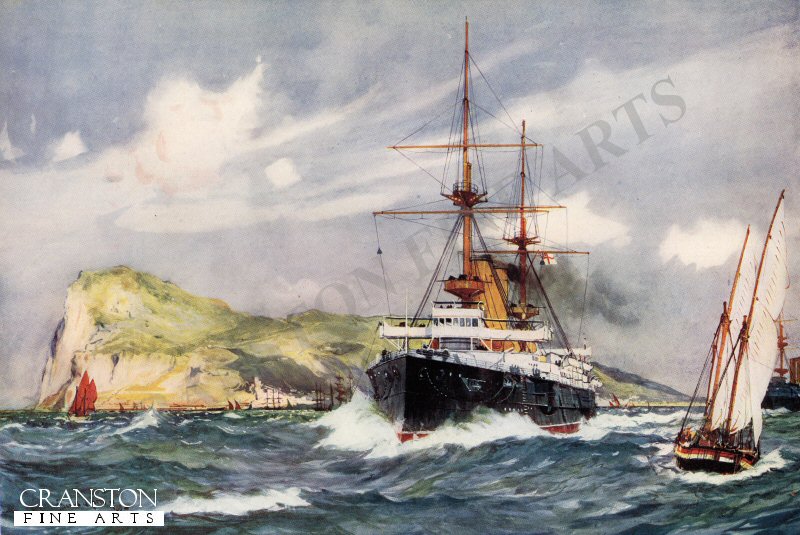
The Canopus off Gibraltar by Charles Dixon. Published in 1901 by George Newnes Ltd, this is an original book plate from a large format naval book. These may have some text from the book on the rear of the book plate, but this does not detract from the framed image. Only a few of these original book plates are still available today, more than a century after they were first published. |
The Canopus opening fire on Admiral Graf Von Spees Fleet from behind a tongue of land at the Falklands Islands. When the fleet of Admiral Graf von Spee was about six miles off the Falkland Islands, and was rushing unawares into a deadly trap, the Canopus opened fire at the leading ships with her 12-inch guns from behind a tongue of land, which concealed her position. The enemy thereupon altered their course, turning slightly away. Soon afterwards, when as it seemed, they had detected the tripod masts of the great British cruisers behind the hills, they suddenly made a half turn to starboard. |
HMS Canopus  Launched : 13th October 1897 HMS Canopus. Built at Portsmouth Dockyard and laid down on the 4th January 1897, launched 21st June 1898 and completed December 1899, at a cost of £783,721. Only one of the class to serve in the Mediterranean fleet instead of the China station until returning to the Channel fleet in 1906 and in that year went into refit, to receive dire control. Further refitting was done while with the reserve at Portsmouth with reduced crew in 1908 - 09, on returning to the fleet she served as the parent ship for the 4th Division at the Nore and with the home fleet from May 1912 and again refitted at Chatham dockyard In 1913. HMS Canopus was stationed at Pembroke and at the outbreak of the great war joined the 8th battle squadron of the Channel fleet, under Admiral Stoddart on the Cape Verde Station and acted as guardship at St Vincent, and then to Abrolhos Rocks a coaling Station in the South Atlantic. Soon after she was sent to the Falkland Islands When HMS Canopus arrived at Port Stanley in bad condition and needing repairs. Admiral Cradock was concerned with the poor sailing speed of the Canopus. The Canpus was separated from the main fleet and was ordered to sail with two colliers to sail to the Island of St. Felix where they were to await the fleet. But the fleet never arrived as they were decimated by the German squadron. The Canopus returned to Porrt Stanley where she became berthed in the mud at the entrance of the port, under captain Heathcoat Grant. With the German squadron expected to attack, HMS Canopus guarded the entrance with her 12-inch guns, as well as the outer entrance was mined and also there were three batteries of twelve pounders. HMS Canopus was the only ship at Port Stanley when Von Spee's ships appeared. Canopus opened fire with the first shot in the battle of the Falkland Islands. Due to this fire and also seeing the tripod masts of the battlecruisers Invincible and Inflexible, Von Spee withdrew his ships. If he has attacked Port Stanley he certainly would have inflicted major damage. After the destruction of Von Spees squadron, HMS Canopus returned to Abrolhos Rocks. From February 1915 she was sent to the Mediterranean to support the Dardanelles expedition. While there she had a narrow escape from a torpedo from a German submarine, the same night her sister ship HMS Ocean was sunk. HMS Canopus was also damaged by Turkish gunfire on 28th April and 2nd May 1915, and was involved in grounding off Gaba Tepe. In October 1915 she transported troops to Salonika. She returned to Chatham docks on Tuesday 2nd May 1916. On returning back to Britain she became the guard ship on the East Coast until 1918 when she was sent to Devonport, where she became a accommodation ship until being sold to the breakers in 1920. Displacement: 12,950 tons. Length: 410 ft. Beam: 74 ft. Draught: 26.5 ft. Complement: 750. Armament: four 12 ins guns, twelve 6 ins guns, ten 3 ins guns, six 3 pounder guns and two maxims with four torpedo tubes. The crew of HMS Canapus on commissioned was Officers: Executive Officers 27, Civil Branch officers 16 and Warrant Officers 6. All Ratings (Seaman Class) 356. Signalmen 11 Engine Room Staff 142 Artisans 28 Sick Berth Staff 3 Accounting Staff 5 Naval Police, Cooks, Bandsman 41 Royal Marines Royal Marine Artillery 50 Royal marines (Royal marine Light Infantry) Scrapped 18th February 1920. |
|
Contact Details |
|
Sign Up To Our Newsletter!
This website is owned by Cranston Fine Arts. Torwood House, Torwoodhill Road, Rhu, Helensburgh, Scotland, G848LE Contact: Tel: (+44) (0) 1436 820269. Email: cranstonorders -at- outlook.com
|
 |