|
|
|
|
|
|
|
|
|
UK Aircraft Carriers Print List
Naval Art  Countries Royal Navy Ship Lists by Type Countries Royal Navy Ship Lists by Type  Aircraft Carriers Aircraft Carriers |
[UP] - Battleships - Aircraft Carriers - Cruisers - Submarines - Destroyers - Assault Ships - Auxiliaries - Submarine Depot Ships - Sailing Ships |
|
|
| Navigation | |
| Page 3 of 4 | Previous .. Page 3 .. Next |
|
|
|
|
|
|
|
|
|
|
|
|
|
|
|
|
|
|
|
|
|
| Navigation | |
| Page 3 of 4 | Previous .. Page 3 .. Next |
| Text for the above items : |
HMS Ark Royal by Brian Wood. HMS Ark Royal part of Force H along with the Battleship HMS Renown and Cruiser HMS Sheffield departs Gibraltar to take part in the search for the Bismarck in the Atlantic. During the hunt HMS Ark Royal, Swordfish mistakenly attack the Royal Navy cruiser HMS Sheffiled. Fortunately, the torpedoes were not primed properly and crusier recieived no major damage. Spotter planes from HMS Ark Royal eventually found the Bismarck. and a attack commenced, crippling the Bismarcks rudder. The damage sustained lead to the rest of the Royal Navy surface fleet catching up with the Bismarck and sinking her. HMS ark Royal returns to the mediteranean. later on 13 November 1941: While on her return to Gibraltar in company with the HMS Malaya, HMS Argus, and HMS Hermione supported by Seven destroyers, HMSArk Royal is attacked by the U-81 under the command of Kapitanleutnant Guggenberger in the Mediterranean., and at 1541, a torpedo strikes the starboard side and the ship immediately takes a 10 degree list. within 20 minutes this list has increased to 18 degrees and Captain Maund orders all only essential crew to remain aboard with the rest of the crew to abandon ship. Destroyer HMS Legion under the command of Commander R. S. Jessel comes alongside and takes most of her crew on board, leaving 250 crew and t Captain Maund to try and save the ship but they have to also abndon ship, and just 14 hours after the torpedo strike HMS Ark Royal rolls over and sinks. from the entire crew their was only only one fatality,Able Seaman E. Mitchell was killed. |
HMS Hermes - Under Leaden Skies by Ivan Berryman. Laid down as early as June 1944, HMS Hermes (R12) was not commissioned into the Royal Navy until 25th November 1959. This fine ship has enjoyed a long and varied career, perhaps its most notable role being that of flagship to the British Task Force that was sent to liberate the Falkland Islands following the Argentine invasion of 1982. She was decommissioned in 1984 and sold to the Indian Navy, whereupon she was renamed Viraat. Hermes is depicted here in stormy weather in the late 1970s before the Harrier 'ski jump' was added to her bow in readiness for the Falklands Campaign. |
Task Force by Michael Turner. Sea Harriers being launched from HMS Invincible during the Falklands conflict. |
HMS Glorious by Ivan Berryman. HMS Glorious flying off a Fairey Swordfish at sunset with HMS Ardent off to Starboard. |
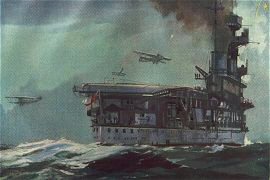
Fast and Furious by Stan Stokes. Thomas Sopwith was a distinguished British aviator who organized the Sopwith Aviation Company. Sopwith produced an aircraft which won the coveted Schneider Trophy race. With the start of WW I, Sopwith Aviation shifted its focus to military aircraft, and was to become one the major suppliers to both the Royal Air Corps and the Royal Naval Air Service. In October of 1914 two Sopwith Tabloids flew a 200-mile round trip strike against the airship sheds at Dusseldorf and Cologne. The Sopwith Strutter firmly entrenched Sopwith as a producer of quality-built aircraft. The Strutter was a precursor of the Sopwith Pup, which would serve as the Royal Navys first carrier aircraft. The first production Pup was delivered to the Royal Navy in 1916. Most Pups were powered by a 80-HP Le Rhone radial engine, which gave the Pup a top speed of 115-MPH and an endurance of three hours. Many Navy Pups were modified to utilize a tripod mounted Lewis gun which could be fired forward or upwards through a cutout in the upper wing. Sopwith Pups were also utilized on battlecruisers. In fact, a Pup launched from the HMS Yarmouth downed the Zeppelin L.23 in August of 1917. The Royal Navys HMS Furious was the first dedicated aircraft carrier in the world. The Furious was initially laid down as a battlecruiser, but the design was modified during construction to include a flying deck forward of the main bridge. This configuration allowed aircraft to be launched as the Furious steamed into the wind. An attempt at recovery by having aircraft side slip on to the deck proved ineffective with one of the early attempts resulting in the death of the pilot, Squadron Commander E. H. Dunning, who had made the worlds first successful carrier landing on a ship underway only days earllier. The Royal Navy decided to further modify the Furious by adding a second deck aft of the bridge. The fore and aft decks were connected by a narrow ramp on either side of the funnel and bridge, and this permitted aircraft to be to moved between the two decks. Sets of longitudinal wires were set across the aft deck, and were designed to catch the skids of the Sopwith Pups during landings. Recovering aircraft was still tricky, and a rope barrier was erected aft of the mainmast to prevent aircraft which overshot from crashing into the superstructure of the ship. The first carrier-based naval air strike in history was carried out against the Zeppelin hangars at Tondern by the Furious on July 19, 1918. Seven Sopwith Camels, each carrying two 50-pound bombs were utilized for this mission. This important moment in the history of naval aviation is captured magnificently in Stan Stokes highly detailed painting entitled Fast and Furious. |
South Atlantic Task Force by Robert Taylor. H.M.S. Hermes prepares to launch her Sea Harriers whilst a Sea King stands off: H.M.S. Arrow in the foreground ploughs into the swell, whilst H.M.S. Sheffield keeps station off the port beam. Following are H.M.S. Glamorgan and the auxiliary Fleet Tankers Olna and Resource. |
To Sink the Bismarck by Gerald Coulson. It is 7.15pm on 25th May 1941. The place, North Atlantic. The mission to find and sink the massive German warship Bismarck. The weather was very bad and worsening noticeably with storm force winds, rain squalls and increasingly heavy seas. With seemingly impossible flying conditions, Ark Royal launched its second strike of the day of fifteen swordfish, four each from 810 and 818 squadrons and seven from 820 squadron. Coming under intense fire the pilots came in very low and close and dropped their torpedo on the target. Eventually the Bismarck's fate was sealed by the guns of the Home Fleet. |
NTG03 - Task Force to Iraq by Ivan Berryman. Key ships of the British task force sail in close formation in the Mediterranean sea during the build up to the coalition invasion of Iraq in march 2003, nearest is the flagship HMS Ark Royal with the commando carrier HMS ocean to her port side. other ships include a Type 42 destroyer , the Fleet Auxiliary Fort Victoria and an LSL. |
HMS Vanguard by Ivan Berryman. Britain's last great battleship HMS Vanguard in company with the aircraft carrier HMS Indefatigable. |
British Pacific Fleet by Randall Wilson. HMS Howe leads Victorious and Implacable through the Malacca Straits. |
Ark's Angels by Randall Wilson. Depicted late in her long serving deployments Ark Royals Bricks make a pass as they return from a low level interdiction exercise. |
NTG03 - Task Force to Iraq by Ivan Berryman. Key ships of the British task Force sail in close formation in the Mediterranean Sea during the build-up to the coalition liberation of Iraq in march 2003. Ships pictured left to right, include ATS Argus (A135), a Type 42 destroyer in the extreme distance, the flagship HMS ark Royal (RO7), RFA Orangeleaf (A110), LSL Sir Percival (L3036), the Commando and helicopter carrier HMS ocean (L12) and the Type 42 destroyer HMS Liverpool (D92) |
HMS Eagle and HMS Albion by Ivan Berryman. HMS Eagle and the commando carrier HMS Albion during the withdrawal from Aden in November 1967. One of HMS Eagles Sea Vixen is passing overhead and RFA Stromness is at anchor in the distance. |
Victory Parade by Ivan Berryman Ships of the Falklands Task Force formate following the Argentine surrender in 1982. Nearest is Leander class frigate HMS Andromeda with RFA Brambleleaf in her wake. The Type 22 frigate HMS Brilliant is to the left of the picture, with the carrier HMS Invincible dominating the right. HMS Hermes and her escorts are in the extreme distance. |
HMS Anson at Sydney Harbour, July 1945 by Ivan Berryman. The King George V class battleship HMS Anson is pictured in Sydney Harbour where she joined the Pacific Fleet in July 1945, viewed across the flight deck of HMS Vengeance, where ten of her Vought F4.U Corsairs are ranged in front of a single folded Fairey Barracuda |
HMS Hermes by Frank Mason. No text for this item |
The Colossus Class Aircraft Carriers 1944-1972 by Neil McCart No text for this item |
Harrier Carriers Vol.1 HMS Invincible by Niel McCart Seven chapters of highly readable text tell the story of the first of the Royal Navys new generation of aircraft carriers. This book traces HMS Invicibles carerr from the traumatic beginnings in the early 1970s when she was known as a through deck carrier, to the early years of the 21st century. During the last 24 years she has faced threats from politicians at home and from the Argentine Air Force in the South Atlantic, but has emerged unscathed. |
Moving Bases. Royal Navy Maintenance Carriers and Monabs by Cdr David Hobbs MBE RN Retd. In this ground-breaking book Commander David Hobbs, a former Royal Navy pilot, describes the logistic support that enabled British aircraft carriers to carry out extended operations across the globe during World War 2 and the Korean Conflict. The deployment of specialised aircraft and component maintenance ships together with mobile air bases as key elements of the deployed fleets allowed the Royal Navy to fight as professional equals alongside the US Navy in the Pacific and Indian Oceans. The book brings together original material and images, much of which is previously unpublished. |
HMS Hermes 1923 & 1959 by Neil McCart with foreword by Rear-Admiral K A Snow No text for this item |
HMS Glory 1945-1961 by Neil McCart in association with the Fleet Air Arm Museum No text for this item |
|
Contact Details |
|
Sign Up To Our Newsletter!
This website is owned by Cranston Fine Arts. Torwood House, Torwoodhill Road, Rhu, Helensburgh, Scotland, G848LE Contact: Tel: (+44) (0) 1436 820269. Email: cranstonorders -at- outlook.com
|
 |