|
|
|
|
|
|
|
|
|
UK Sailing Ships Print List
Naval Art  Countries Royal Navy Ship Lists by Type Countries Royal Navy Ship Lists by Type  Sailing Ships Sailing Ships |
[UP] - Battleships - Aircraft Carriers - Cruisers - Submarines - Destroyers - Assault Ships - Auxiliaries - Submarine Depot Ships - Sailing Ships |
|
|
| Navigation | |
| Page 4 of 16 | Previous .. Page 4 .. Next |
|
|
|
|
|
|
|
|
|
|
|
|
|
|
|
|
|
|
|
|
|
| Navigation | |
| Page 4 of 16 | Previous .. Page 4 .. Next |
| Text for the above items : |
HMS Resolution - Polar Explorer by Ivan Berryman. (PC) Originally a North Sea Collier named the Marquis of Granby, HMS Resolution was purchased by the Royal Navy and fitted out with all the very latest navigational aids and a water purification system in readiness for Captain Cook's second voyage to the Pacific in 1772. During this voyage, in 1773, Resolution became the first ship to cross the Antarctic Circle, entering the southern polar region on three occasions. Resolution was also Cook's choice for his third voyage in 1776 when she crossed the Arctic Circle twice in 1778 and 1779. Following her voyages of discovery, she returned to cargo duties, but her ultimate fate is unclear, as she was captured by the French in June 1782 and was never heard of again. |
The Victory by Derek Gardner. No text for this item |
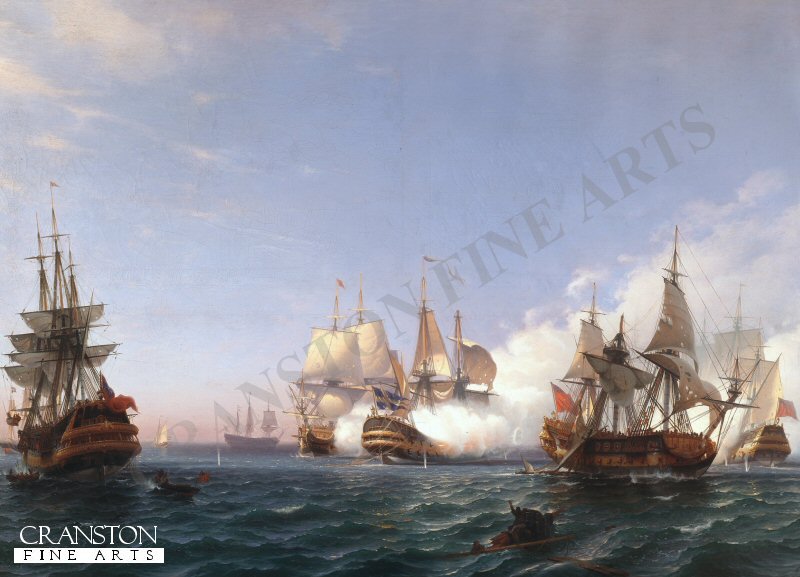
Lord Nelson at the Battle of Copenhagen by Arthur David McCormick (PC) The Battle of Copenhagen, fought on August 2, 1801, was a naval conflict between the British Royal Navy and the Danish-Norwegian fleet during the Napoleonic Wars. The British, led by Admiral Sir Hyde Parker and Vice-Admiral Horatio Nelson, aimed to neutralize the Danish fleet, which was allied with France and a potential threat to British maritime dominance. Despite fierce resistance from the Danes, Nelson's daring tactics and aggressive strategy led to a decisive British victory. |
Bartholomew Roberts (Black Bart) by Chris Collingwood. Bartholomew Roberts was born in Wales in the village of Little Newcastle which lies between Fishguard and Haverfordwest in Pembroekshire in 1682. His name was originally John Roberts, but he took up the name of Bartholomew Roberts which he may have taken after hearing of a well known pirate Bartholomew Sharp. It is believed in 1695 at the age of 13 Bartholomew Roberts went to sea but was not heard of until 1718 when he was a mate on a Barbados Sloop. In the following year he served on a slave ship the Princess of London as the third mate serving under Captain Abraham Plumb. In June 1718 the Princess of London was captured by two pirate shipe, the Royal Rover and the Royal James as she lay at anchor at Anomabu on the Gold Coast. The pirates were led by a Welshman named Captain Howell Davis. It seems that Davis liked Roberts who along with many of the crew of the Princess of London joined the pirates. Roberts soon showed his worth as a good navigator, and would often talk to Davis in welsh so that the other pirates would not understand their conversation. Bartholomew Roberts pirate career latest between 1719 and 1722 and he was the most successful pirate of this period, capturing over 470 ships, far more ships than some of the best-known pirates of this era such as Blackbeard and Captain Kidd. Although never used during his life time he is now often refered to as Black Bart. Captain Roberts was killed on the 10th of February 1722 , at Cape Lopez while trying to avoid and escape the British warship HMS Swallow. He was killed by grapeshot fired form the Swallow - while standing on the deck was hit in the throat. His wish was to be buried at sea and his crew quickly wrapped his body in sail and weighted it down, so that it would not be captured by the British. His body was never found. |
The Battle of Copenhagen, 2nd April 1801 by Ivan Berryman. The key to Nelsons victories always lay in his meticulous planning and the Battle of Copenghagen was no exception as he used his fleet to first destroy the Danish floating defences so that his bomb vessels could be brought up to bombard the city itself. The Danes eventually capitulated, but they had fought hard and over 2,000 men had died on both sides before the end of the battle. In this view, HMS Elephant, carrying the flag of Vice Admiral Horatio Nelson, dominates the scene as the battle gathers intensity. British ships depicted, left to right, are the Glatton (54), Elephant (74), Ganges (74) and Monarch (74) |
Java and Constitution by Montague Dawson. The battle between HMS Java and USS Constitution on 29th December 1812. HMS Java was captured during this action and was set ablaze by the victors 2 days after the battle, the captured ship so damaged it was deemed unworthy of being taken. |
Admirals All by Arthur David McCormick (PC) Part of the classic collection. |
Flying Cloud by Robert Taylor. The American Clipper Flying Cloud arrives at Hong Kong in May 1860, 97 days out of London. En-route to Foochow, she will load tea for the return voyage. Of all the famous American Clippers Flying Cloud had by far the best record. |
The Majestic at the Battle of the Nile 1798 by Charles Dixon. Published in 1901 by George Newnes Ltd, this is an original book plate from a large format naval book. These may have some text from the book on the rear of the book plate, but this does not detract from the framed image. Only a few of these original book plates are still available today, more than a century after they were first published. |
Battle of Trafalgar, 21st October 1805 - The Close of Action by Nicholas Pocock. The aerial view shows the scene of devastation at around 6pm with the British ships lying alongside their prizes in the foreground, and the remaining French ships fleeing in the distance. |
The Battle of Navarino by Charles Dixon In this naval battle France, Russia and Britain were engaged against the Ottoman Turks. The Allies fought bravely in concert, and on more than one occasion acted very chivalrously towards one another. At one moment the little British frigate Talbot was furiously attacked by a number of large enemy ships and was in desperate plight when the French warship Armide screened the British ship. The Rose assisted the Armide and Russian frigates also helped to achieve victory. |
Boarding the San Nicolas by Chris Collingwood. (GL) Nelson's sailors and marines board the San Nicolas and during heavy hand to hand fighting capture the ship. Nelson drives HMS Captain onto the Spanish vessel in order that she can be boarded and taken as a prize, the British marines and men scrambling up the Captain's bowsprit to use it as a bridge. The San Nicolas then fouled the Spanish three-decker San Joseph, allowing Nelson and his men to take both ships as prizes in a single manoeuvre. |
Battle of the Copeland Islands by David Pentland. USCS Ranger captained by John Paul Jones attacks and defeats HMS Drake off the Copeland Islands at the mouth of Belfast Lough. This was the first battle of the newly formed American Continental Navy. |
The Oland, Fighting with English Men-of-War in 1704 by Albert Berg (PC) The Battle of Orford Ness, on July 25, 1704, saw an engagement between British and Swedish vessels. The Swedish warship Oland was escorting a Swedish convoy when an English squadron approached and demanded the Swedes salute them due to their presence in English waters, however, the Swedish ships refused and a lengthy battle ensued. The Oland was captured along with its commander, eventually being released upon demand of Charles XII. The Oland sunk north of Denmark during the journey back to Sweden however. |
HMS Victory by Ivan Berryman. Arguably the best known warship in the world, and one of only a few survivors of her era, HMS Victory was the flagship of Admiral Lord Horatio Nelson at Trafalgar in 1805, leading the victorious British fleet into battle against the combined French and Spanish navies. Severely damaged during the battle, she remained afloat at Portsmouth into the 20th century and is now preserved there in dry dock for future generations to visit. Extraordinarily, HMS Victory is still a commissioned ship in the Royal Navy and is frequently used for ceremonial duties. |
The Battle of Trafalgar by John Christian Schetky (PC) Nelsons fleet, comprising 27 ships, faced 33 enemy vessels but employed innovative tactics that included breaking the enemy line, allowing his forces to engage the enemy at close range. Not a single British vessel was lost that day, with the enemy having 1 ship sink and 17 captured. The victory at Trafalgar ensured that Britain would remain a dominant maritime power and thwarted Napoleons plans to invade England. |
Agamemnon off the Needles by Ivan Berryman. Considered by Lord Nelson as The finest 64 in the Service - indeed, his favourite ship, HMS Agamemnon was a two-deck third rate warship, lighter and faster than most 74s. Launched at Bucklers Hard in 1781, she saw action in many great battles, among them the Battle of Ushant, the Battle of Copenhagen and Trafalgar, by which time she was a veteran of 24 years service. |
The Hero of Trafalgar by William Hersman Overend. Depicting Nelson on the deck of HMS Victory, during the Battle of Trafalgar. |
Cutting Out of the Hermione (Retribution) 1799 by Charles Dixon. Published in 1901 by George Newnes Ltd, this is an original book plate from a large format naval book. These may have some text from the book on the rear of the book plate, but this does not detract from the framed image. Only a few of these original book plates are still available today, more than a century after they were first published. |
Defeat of the Spanish Armada by Stan Stokes. No text for this item |
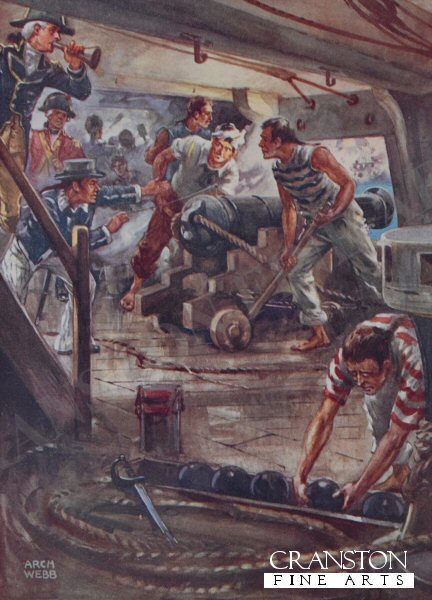
Each Gun From its Adamantine Lips by Archibald Webb British gun crews below decks, manning the cannons during the Battle of Trafalgar |
|
Contact Details |
|
Sign Up To Our Newsletter!
This website is owned by Cranston Fine Arts. Torwood House, Torwoodhill Road, Rhu, Helensburgh, Scotland, G848LE Contact: Tel: (+44) (0) 1436 820269. Email: cranstonorders -at- outlook.com
|
 |