|
|
|
|
|
|
|
|
|
UK Sailing Ships Print List
Naval Art  Countries Royal Navy Ship Lists by Type Countries Royal Navy Ship Lists by Type  Sailing Ships Sailing Ships |
[UP] - Battleships - Aircraft Carriers - Cruisers - Submarines - Destroyers - Assault Ships - Auxiliaries - Submarine Depot Ships - Sailing Ships |
|
|
| Navigation | |
| Page 6 of 16 | Previous .. Page 6 .. Next |
|
|
|
|
|
|
|
|
|
|
|
|
|
|
|
|
|
|
|
|
|
| Navigation | |
| Page 6 of 16 | Previous .. Page 6 .. Next |
| Text for the above items : |
The Battle of La Hogue by Benjamin West (PC) The Battle of La Hougue took place on June 3rd, 1692. In this encounter the English successfully attacked a French fleet anchored at La Hougue. They inflicted significant damage, sinking several ships and capturing others. The English fleet, consisting of about 90 ships, was well-prepared for the engagement and took the French vessels completely by surprise, as they had been anchored in the presumed to be safe shallow waters off La Hogue. This would contribute to their downfall however as the shallow waters meant the French ships could not properly manoeuvre. |
Line of Battle by Ivan Berryman. As Nelsons column of ships began their approach to the French and Spanish fleet at the start of the Battle of Trafalgar on 21st October 1805, the first four ships to break through were to be HMS Victory at the head of the line, HMS Temeraire, HMS Neptune and the 74-gun two-decker HMS Leviathan. Afraid for his admirals safety in the lead ship, Captain Harvey of the Temeraire decided to break away from the line in order to overtake Victory and be the first ship through, thus taking the worst of the gunfire from the enemy line as they approached. However, it was admiral Nelsons habit always to lead from the front and, as Temeraire manoeuvred alongside Victory, Nelson took up his speaking trumpet, went to his ships side and sternly shouted "I will thank you, Captain Harvey to maintain your proper station which is astern of the Victory". Harvey comlpied at once and the fleet continued into battle as originally planned. |
Admiral Nelsons Victory at the Battle of the Nile by Graeme Lothian. No text for this item |
Farewell, Old Portsmouth by Ivan Berryman. One of the most iconic ships of all time and now beautifully restored to her 1805 condition at Portsmouth, Nelson's flagship at the Battle of Trafalgar, HMS Victory, is seen here departing Portsmouth Harbour with the frigate Euryalus. |
Spitfire Clipper by Robert Taylor. Tea carried down the Min River from the plantations on Chinese junks, is loaded aboard the American clipper Spitfire in Pagoda Anchorage, Foochow, October 1857. In this busy port scene a steam tug approaches, indicating the Clipper is almost ready to sail for London, a voyage that she will complete in 113 days. Roberts exquisite rendition is now available as a limited edition print. |
The Bombardment of Tripoli, 1804 by Ivan Berryman. Ships of Commodore Preble's Mediterranean Squadron are shown during the action of 3rd August 1804 when they provided support to the gunboats and mortar boats as they pounded the defensive walls and xebecs that were defending Tripoli. In the left foreground, the bomb boat Robinson rolls as she fires her mortar whilst the brig Argus takes up station behind Constitution, both of which are firing broadsides. The brig Syren is in the far distance, engaging more of the Tripolitan xebec gunboats, having cut inside of Constitution to engage the enemy more closely. |
Ariel and Taeping by Montague Dawson. No text for this item |
The Prince George at the Battle of Malaga 1704 by Charles Dixon. Published in 1901 by George Newnes Ltd, this is an original book plate from a large format naval book. These may have some text from the book on the rear of the book plate, but this does not detract from the framed image. Only a few of these original book plates are still available today, more than a century after they were first published. |
Cutty Sark by Barry Price. No text for this item |
Hornblower and the Indefatigable by Robert Taylor. Winter in the Bay of Biscay brings ferocious gales and bitter cold discomfort for ships crews aboard the British frigate Indefatigable. Horatio Hornblower, C.S. Forresters dashing eighteenth-century naval officer, experienced the worst of conditions at sea while serving the arduous task of blockading the ports off the west coast of France. The excitement of battle came as welcome relief. Roberts magnificent painting depicts an exchange of cannon fire between Indefatigable - on the left - and a 40-gun French frigate attempting to run the blockade on a chill winters morning. Moments later the two hulls crashed alongside each other, and the Frenchman was boarded and taken. |
HMS Captain at the Battle of Cape St Vincent by Ivan Berryman Viewed across the damaged stern of the 80-gun San Nicolas, Nelson drives HMS Captain onto the Spanish vessel in order that she can be boarded and taken as a prize, the British marines and men scrambling up the Captains bowsprit to use it as a bridge. The San Nicholas then fouled the Spanish three decker San Joseph (112), allowing Nelson and his men to take both ships as prizes in a single manoeuvre. A British frigate is moving into a supporting position in the middle distance. |
The Tenacious Belleisle by Ivan Berryman. Few ships fought more bravely than HMS Belleisle at the Battle of Trafalgar. Having been second in the line of Collingwood’s leeward division, the 74-gun Belleisle took on a number of opponents including the Monarca, Santa Ana and Indomtable, but soon found herself surrounded by enemy ships that poured weighty broadsides into her. By 2.30 in the afternoon, Bellisle was little more than a floating wreck, having lost all of her masts and bowsprit, yet still she fought bravely on, her colours flying defiantly from the stump of her mizzen mast. Belleisle survived her ordeal and was towed to Gibraltar after the battle where temporary repairs were made, arriving in Plymouth for a refit on 5th December 1805. |
HMS Sirius at Anchor by Ivan Berryman As dusk falls, a 28ft Pinnace makes its way through mirror-calm waters toward the 36 gun frigate HMS Sirius as she lies at anchor in Plymouth, early in March, 1804. She was lost in 1810 when her crew scuttled her after she grounded during the Battle of Grand Port. |
Riding the Ninth Wave by Ivan Berryman. (P) Sailors on a clipper during a storm. |
Troops Embarking for the Crimea by William Stuart. No text for this item |
Nelsons Victory at Trafalgar by Anthony Saunders Undoubtedly the most famous and decisive battle in the history of naval warfare. The battle of Trafalgar was fought on a calm, almost windless day, on 21st October 1805. Nelsons revolutionary battle plan was to cut apart the larger Franco-Spanish fleet of Vice-Admiral Villeneuve by sailing in two single column divisions directly at right angles into the combined fleet and thus rendering almost half of the leading ships useless until they could turn and join the fight, which in such calm conditions could take hours. The battle raged for five hours in which time not one British ship was lost, however, Nelson would tragically lose his life at the very moment of his triumph, a triumph which rendered the British Navy unchallenged in supremacy for over a century. Here, Nelsons flagship, HMS Victory, followed by HMS Temeraire is seen breaking the Franco-Spanish line and commencing her murderous hail of gun fire into the stern of Villeneuves flagship, Bucentaure. Meanwhile the Victory herself is being fired upon by the French Neptune. Redoutable can be seen at the far right. |
Captain Harveys HMS Temeraire tries to pass HMS Victory at the beginning of the Battle of Trafalgar by Ivan Berryman. 21st October 1805. As Admiral Nelsons flagship leads the British fleet towards the Franco-Spanish line, Captain Harveys Temeraire tries to pass the Victory in order to be the first to break the enemy column. Harvey was discouraged with a customry rebuke from Nelson and duly fell into line behind the flagship. The enemy can be seen spread along the horizon whilst, to the right in the distance, the leading ships of Admiral Collingwoods fleet can be seen spearheading a separate assault to the south. In the light airs preceding the battle, much sail was needed to drive the British ships towards the enemy line. HMS Victory, nearest, has royals and stunsails set and is making good way, her furniture boats strung behind in readiness for battle. On her poop deck, officers prepare to run up a signal. |
HMS Euryalus - Shadowing the Fleet by Ivan Berryman. Launched at Bucklers Hard in Hampshire in 1803, the frigate HMS Euryalus is probably best known for the small part she played at Trafalgar. She was one of four British frigates sent to observe the combined French and Spanish fleets as they left Cadiz for what would become the Battle of Trafalgar. Having shadowed the enemy through the night, Euryalus sped ahead to warn the British fleet, commanded by Admiral Lord Nelson. Too small to play a significant part in the battle itself, Euryalus stood off until the afternoon when she took the badly damaged Royal Sovereign in tow, Admiral Cuthbert Collingwood transferring his flag to the little frigate following the death of Nelson. By 1825, her career as a fighting ship was over and she was decommissioned to become a prison ship until the mid 1840s when she became a coal hulk. She soldiered on in number of other menial roles until 1860 when she was finally broken up. |
Nelsons Chase After The French Fleet, 1805 by Thomas Davidson (PC) After Napoleons forces threatened Britain, Admiral Horatio Nelson sought to disrupt the French fleet, which was anchored at Cadiz, Spain. In October 1805, Nelson, commanding a smaller but more maneuverable British fleet, pursued Vice Admiral Pierre-Charles Villeneuve’s larger French and Spanish fleet. |
The Final Destruction of Bomarsund, September 2nd 1854. On 21st June 1854, three British ships bombarded the Bomarsund fortress. Artillery from the shore responded and while both sides suffered some damage, the casualties were light. The first battle was indecisive. During the battle, Charles Davis Lucas tossed a shell overboard which had landed on board. The shell exploded before it reached water. For saving his ship he was the first man to be awarded the Victoria Cross. The bombardment of the main fortress started late on 15th August 1854 with land based guns and the navy opening fire. The second tower, Notvik, was also destroyed after British artillery opened fire from their hill opposite to the tower. With only a few guns capable of firing in the direction of the bombarding ships, the Russian forces hoped that the French and British forces would attack by land. However, after the bombardment continued into the 16th August without any indication of landings, it became apparent to the Russian commander that the British and French intended to reduce the fortress with artillery fire. After eight hours of bombardment they managed to create a gaping hole in the fortress walls. After most of the guns had been destroyed, the commandant of the tower surrendered to the British and French forces on 16th August 1854. After the surrender, French and British forces demolished the fortress. British engineers remained until mid September to ensure it could not be easily rebuilt. |
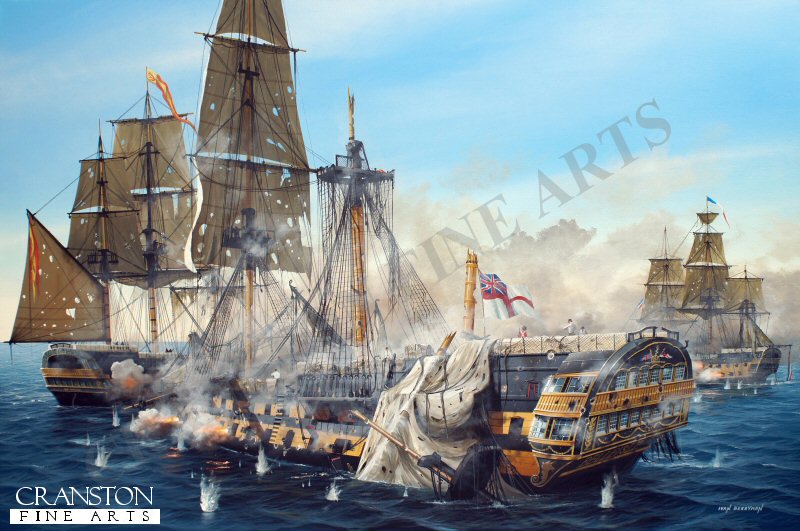
Tugging the Tiger's Tail by Ivan Berryman. It is the Battle of Trafalgar, 21st October 1805 and the British 2nd rater Temeraire with 98 guns, having followed HMS Victory through the Franco-Spanish line, finds herself alongside the Spanish flagship, La Santisima Trinidad. This giant was by some measure the largest warship in the World, boasting four full gun decks and 130 guns. Undaunted, Captain Eliab Harvey took on the Santisima Trinidad, delivering a number of blows into the enemy’s massive red and black hull. However, Temeraire was largely out of control by this time, having taken much punishment as she had approached the enemy fleet. Her main topgallant mast had been shot away, as well as the mizzen topgallant. Her fore yard had crashed down onto her deck and her fore topsail had caught fire and been extinguished. Taking fire from both sides, the Temeraire lumbered on, eventually colliding with Le Redoutable, which was engaged with Victory. Between them, the two British three-deckers poured fire into the French ship until it struck its colours. |
|
Contact Details |
|
Sign Up To Our Newsletter!
This website is owned by Cranston Fine Arts. Torwood House, Torwoodhill Road, Rhu, Helensburgh, Scotland, G848LE Contact: Tel: (+44) (0) 1436 820269. Email: cranstonorders -at- outlook.com
|
 |