|
|
|
|
|
|
|
|
|
UK Sailing Ships Print List
Naval Art  Countries Royal Navy Ship Lists by Type Countries Royal Navy Ship Lists by Type  Sailing Ships Sailing Ships |
[UP] - Battleships - Aircraft Carriers - Cruisers - Submarines - Destroyers - Assault Ships - Auxiliaries - Submarine Depot Ships - Sailing Ships |
|
|
| Navigation | |
| Page 7 of 16 | Previous .. Page 7 .. Next |
|
|
|
|
|
|
|
|
|
|
|
|
|
|
|
|
|
|
|
|
|
| Navigation | |
| Page 7 of 16 | Previous .. Page 7 .. Next |
| Text for the above items : |
The Battle of the Nile, 1798 - The Burning of L Orient by Ivan Berryman. Nelsons annihilation of the French Fleet at Aboukir Bay was complete, but for the escape of Admiral Villeneuve who would again confront his nemesis just seven years later at Trafalgar. Doubled by the British ships and ravaged by their relentless gunnery, the French faced utter defeat as the battle raged into the night. At the centre of the French line lay the massive three decker L Orient. The British Alexander positioned herself astern of L Orient and began to fire mercilessly into her fragile stern galleries. Within a short time, a terrible fire started that raged through her hull, eventually reaching her powder magazine, causing a massive explosion that literally blew L Orient to pieces. In this scene, shortly before the explosion, Alexander can be seen astern of the burning L Orient, minus her maintop, and trying to move away in the intense heat. To her port, the British Majestic is also starting to slip away while, in the foreground, the French Franklin is ablaze and threatened with being caught in the imminent blast. At the extreme right of the picture, crews are racing to remove sails from the British Orion to lessen the risk of fire in the event of L Orients spectacular demise. |
Battle of Trafalgar by Thomas Whitcombe. No text for this item |
Lord Nelson by Christian Symons. No text for this item |
Glory and Valiant by Derek Gardner. No text for this item |
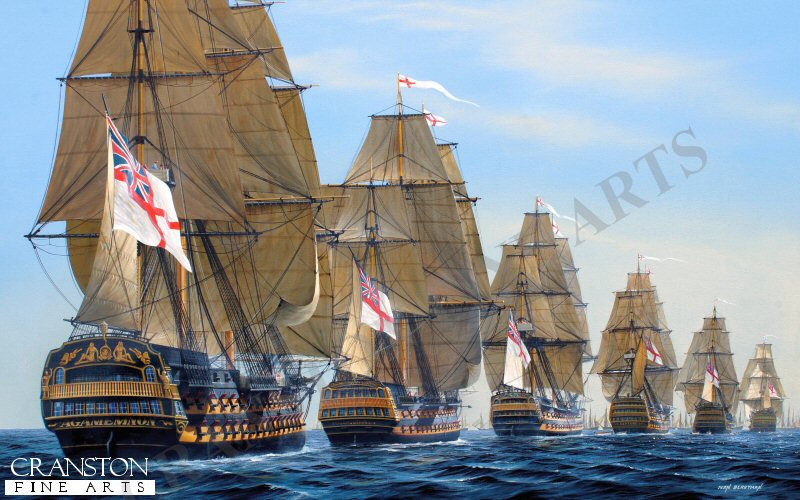
In Destinys Hands, Trafalgar, 12:15 PM by Ivan Berryman It is approximately 12,15 pm on 21st October 1805. With the combined Franco-Spanish enemy line in the far distance, HMS Victory is just beginning to manouevre, having chosen the French flagship Bucentaure as her target. Behind Victory lies Temeraire, then Neptune, followed by the two-deckers, Leviathan and Conqueror and Agamemnon in the foreground. Victory is flying the signal Engage the Enemy Closely from her main mast. Most ships have their studding sails set on the larboard (port) side only trying to harness as much wind as possible to hasten their approach 1n such light airs. At this stage, the stoves will have been extinguished, the guns run out and all decks cleared for action, their floors strewn with sawdust to avoid slipping and to soak up the blood. The Marines will be in position the officers at their posts and gun crews may likely have been singing hearty songs to raise their spirits. Fate alone knew what awaited them, once the firing started. |
RMS Britannia (1840) off the Angelsey Coast by E. D. Walker. No text for this item |
Nelson by John Hoppner after Healy. No text for this item |
Frigate Action off Antigua by Ivan Berryman. HMS Boreas encounters the French Compas, August 29th 1779. |
The Victory towed into Gibraltar after Trafalgar by William Clarkson Stanfield. No text for this item |
Bomb Ketches Saluting the Victory, December 1805 by Charles Dixon. Published in 1901 by George Newnes Ltd, this is an original book plate from a large format naval book. These may have some text from the book on the rear of the book plate, but this does not detract from the framed image. Only a few of these original book plates are still available today, more than a century after they were first published. |
Battle of the Nile, 1st August 1798 by Nicholas Pocock. No text for this item |
A 74 Gun Ship of the Line About 1794 by W Fred Mitchell (P) No text for this item |
HMS Resolution 1780 by Brian Wood. HMS Resolution was a Royal Navy sloop and the ship in which Captain Cook made his second and third voyages. Along along with HMS Adventure they set sail from Plymouth on the 13th of July 1772. The total crew consisted of 112 including 20 volunteers form HMS Endeavour which was the ship captained by Cook on his first voyage from 1768 to 1771. On 17 January 1773, HMS Resolution was the first ship to cross the Antarctic Circle and crossed twice more on the voyage. HMS Resolution returned to Britain in 1775 and was then paid off, being recommissioned in February 1776 for the third voyage of Captain Cook. It was on this voyage that HMS Resolution crossed the Arctic Circle on 17th August 1778, and again crossed it on 19th July 1779. In this painting HMS resolution is shown arrving back in Britain on 4 October 1780. |
Hearts of Oak by Mark Churms. In January 1793 the 1st Battalion of the 29th Foot leaves Windsor for Hilsea to board Royal Navy fighting ships as there is a shortage of marines. Their new roll is to counter enemy musket fire from the upper decks, to lead boarding parties and to maintain discipline of the crew. They are specially equipped with a new working rig but still retain their full dress red coats and powdered hair (curled locks above the ear are removed) for combat. The regiment joins The British Channel Fleet under Admiral Earl Howe, and detachments are allocated to the following ships of the line; H.M.S. Glory, Thunderer, Alfred, Pegasus and Ramilles. 78 soldiers under the command of Cpt. Alexander Saunders are also placed aboard Captain Harveys 74 gun H.M.S. Brunswick. Howes ships are sent to intercept a fleet, of similar size that has put out from Brest to escort a large convoy of food from America, destined for Revolutionary France. The two fleets make contact but fog prevents an engagement until 1 Oarn on the first day of June 1794. Now, in bright sunshine, the order is given to attack! Brunswick is directly astern of Howes flag ship as the French line is broken. She quickly engages Le Vengeur with which she becomes dangerously entangled. Broadsides are exchanged at point blank range! Sails are shot to ribbons, masts and rigging fall. Grenades, carronades and musketry find their targets and casualties mount. Nevertheless, the ships band, joined by a negro regimental drummer on the quarter deck, keep up moral by playing the new and popular air Hearts Of Oak. The two ships drift helplessly as another French man-of-war, Achille, comes in for the kill but the British gunners deliver such a devastating broadside into this new assailant that she is completely demasted and strikes her colours! In the firefight the figure head, an effigy of the Duke of Brunswick, has its carved wooden hat blown clean away. So, Captain Harvey calmly replaces the loss with his own cocked hat! The captain himself receives a blow to the hand and is subsequently mortally wounded with a section of chain-shot. Cpt. Saunders is killed by a snipers bullet and Lt. Harcourt Vernon (wearing short, non regulation boots to facilitate amputation) is soon wounded as well. The decks are cleared of downed masts and rigging, the dead also go over the side. cl At about one oclock the two interlocked ships are separated by a swell and Harveys brothers ship Ramilles cornes to the Brunsivicks assistance. The crippled Vengeur cannot compete with the skill of English gunnery and the ship is raked from end to end by galling fire. Cheers ring out as she surrenders and hoists the Union Jack. The rest of the French fleet breaks off the engagement. Six of their ships are out of action and Le Vengeur is so very badly holed that she eventually sinks (many of her crew refusing to abandon her. Singing the Marseillaise they re-hoist her battle flag as they slip to their watery grave) This British fleet returns in triumph to Spithead. However, the scene on the Brunswicks splintered poop deck is one of utter devastation. The regiment has 13 officers and men killed, another 18 are wounded and nearly quarter of the ships company is lost. This hard won victory is commemorated by the regiment with Naval Crown (awarded to the regiment in 1909, an honour shared only by the Queens Regiment) and by the adoption of the tune played throughout the height of battle, Hearts of Oak. |
HMS Victory at the Battle of Trafalgar by Graeme Lothian. The time is 1.35pm. (ten minutes after Admiral nelson had been fatally shot) HMS Temeraire and HMS Victory, are seen broadside to the redoubtable, which by 2pm had lost most of her crew, (out of a crew of 643 - 487 were dead, 81 died soon after, and only 25 were fit to crew) |
Sir Frances Drake by Chris Collingwood. No text for this item |
HMS Endeavour by Brian Wood. Captain Cooks ship shown landing a party on the continent of Australia. Initially launched as the Collier Earl of Pembroke in 1764, the ship was purchased by the Admiralty in 1768 for the specific reason of a scientific mission to the Pacific Ocean. Renamed HMS Endeavour and becoming a 10 gun Royal Navy barque, she was captained by Lieutenant James Cook and this was to be his first of three famous voyages. HMS Endeavour set sail from Plymouth in August 1768, returning in 1771. |
In the Thick of Battle by Chris Collingwood. Lieutenant of the Royal Navy commands marines and crew during a sea battle with the French during the battle of Cape St Vincent. |
The Battle of Trafalgar, 2.30pm. The Taking of the Santisima Trinidad by Ivan Berryman. Dominating the centre foreground, the wreck of the largest ship at Trafalgar, the massive four decker Santisima Trinidad (130 guns), comes under further attack from the British Neptune (98 guns) All her masts have fallen, rendering the Spanish giant an unmanageable hulk. Elsewhere, the battle rages on with Temeraire and Victory engaged with the French Redoubtable, while to the right of the picture, the shattered, drifting remains of Villeneuves Bucentaure (80 guns) is approached by the Mars (74 guns) Conqueror (74 guns), off the Santisima Trinidads port quarter, is keeping up a distant fire to assist the Neptune. |
HMS Eurydice at Anchor off Cowes by Ivan Berryman After being re-commissioned under the command of Captain Marcus Augustus Stanley Hare, Eurydice sailed from Portsmouth on a three-month tour of the West Indies and Bermuda on 13th November 1877. On 6th March 1878, she began her return voyage from Bermuda for Portsmouth. After a very fast passage across the Atlantic, on 24 March 1878, Eurydice was caught in a heavy snow storm in Sandown Bay, within sight of the Isle of Wight, capsized and sank. Only two of the ship's 319 crew and trainees survived. Most of those who were not carried down with the ship died of exposure in the freezing waters. One of the witnesses to the disaster was a young Winston Churchill, who was staying at Ventnor with his family at the time. The wreck was re-floated later that same year but had been so badly damaged during her submersion that she was then subsequently broken up. Her ship's bell is preserved in St. Paul's Church, Gatten, Shanklin. There is a memorial in the churchyard at Christ Church, The Broadway, Sandown and the ship's anchor is set into a memorial at Clayhall Cemetery, Gosport. |
The Death of Nelson by Benjamin Well (PC) Part of the classic collection. |
|
Contact Details |
|
Sign Up To Our Newsletter!
This website is owned by Cranston Fine Arts. Torwood House, Torwoodhill Road, Rhu, Helensburgh, Scotland, G848LE Contact: Tel: (+44) (0) 1436 820269. Email: cranstonorders -at- outlook.com
|
 |