|
|
|
|
|
|
|
|
|
UK Destroyers Print List
Naval Art  Countries Royal Navy Ship Lists by Type Countries Royal Navy Ship Lists by Type  Destroyers Destroyers |
[UP] - Battleships - Aircraft Carriers - Cruisers - Submarines - Destroyers - Assault Ships - Auxiliaries - Submarine Depot Ships - Sailing Ships |
|
|
| Navigation | |
| Page 2 of 3 | Previous .. Page 2 .. Next |
|
|
|
|
|
|
|
|
|
|
|
|
|
|
|
|
|
|
|
|
|
| Navigation | |
| Page 2 of 3 | Previous .. Page 2 .. Next |
| Text for the above items : |
HMS Repulse by Ivan Berryman. Wearing her unusual black and white disruptive colour scheme, HMS Repulse is pictured as part of Force Z in company with HMS Prince of Wales and the destroyer Vampire. These two mighty battleships were to be lost within hours of each other, the victims of intense Japanese air strikes. Vampire and the destroyer Electra were on hand to pick up survivors from both ships. |
HMS Cossack by Ivan Berryman. HMS Cossack, one of the fast Tribal class destroyers will always be remembered for the daring rescue of 300 prisoners of war from the German Altmark in Norwegian waters. She is shown here departing Grand Harbour, Malta. |
HMS Hood - Operation Catapult by Anthony Saunders The pride of the British fleet, The Mighty Hood as she was known, was launched in 1918. Weighing in at over 40,000 tons she was 860 feet long and had eight 15 inch guns, at her launch she was more than a match for any adversary. Hood sailed the world in the inter-war years and was admired in every foreign port she visited, however with a lack of major refits in this time the second world war found the Hood unprepared for a major battle, On the 24th of May 1941 the German battleship Bismarck found Hoods achilles heel within only a few salvos, namely her inadequate deck armour. Hood exploded in a huge fireball from which only three sailors survived. Here HMS Hood is seen with Force H in the Mediterranean. Winston Churchill knew that the powerful French fleet at Mers-el-Kebir could fall into German hands at any time and that the threat had to be removed by any means. On the 3rd of July 1940 the French fleet was duly dispatched by Force H. The Strasbourg being the only French battleship able to make her escape. Hood is depicted opening fire at 17.55 hours with the battleships Resolution and the destroyer HMS Foxhound to her stern. |
The Raid on St Nazaire 28th March 1942 by David Rowlands. In early 1942 Britains very survival was threatened by the success of German U-Boat raids on shipping in the Atlantic. their mighty battleship Tirpitz posed even a greater threat. Operation Chariot a sea -borne commando attack was launched on a huge Normandie dock in the heavily defended St Naziare harbour. Destruction of the dock would deprive the Germans of the only repair site on the Atlantic coast big enough for the 50,000 ton Tirpitz. Accompanied by 18 small craft of Coastal Forces. HMS Campbletown boldly steamed up three Loire estuary under intense German fire, and struck the caisson of the dry dock at 0134 hrs. The Commandos rapidly disembarked from the bows and set about destroying the dock installations, Of the 622 who set out from Falmouth 169 died, 200 became prisoners and only 242 returned home. Five Victoria Crosses, four DSOs, seventeen DSCs and eleven MCs were awarded in the daring and brilliantly successful raid. |
Dunkirk by Ivan Berryman. Between 24th may and 4th June 1940 an extraordinary armada of craft, large and small, naval and civilian, embarked on one of the greatest rescue missions in history. the evacuation of 330,000 British and French troops from the beaches of Dunkirk in northern France. the destroyer HMS Shikari dominates the foreground here as troops pour onto the beaches and harbour moles in search of salvation. MTB are seen picking up troops and taking them to ships further out including MTB102. Also shown is a paddle steamer with very shallow draft taking on troops close to the beach and in the distance HMS Grafton can be seen taking troops from the mole. She was lost later during the evacuation. |
Three Lions by Ivan Berryman. Representing three distinctive types operated by the Royal Navy in the 1980s, HMS Invincible (RO5) is depicted in company with HMS Naiad (F39), an Ikara Leander frigate and the unique Type 82 destroyer HMS Bristol (D23). |
The attack on the Admiral Hipper by HMS Glowworm by Ivan Berryman. HMS Glowworm, burning severely after receiving hits from the mighty Admiral Hipper, is depicted turning to begin her heroic sacrifice off the Norwegian coast on 8th April 1940. Hugely out-gunned and already crippled, Glowworms captain, Lieutenant-Commander Roope rammed his destroyer into the side of the Admiral Hipper, inflicting a 40 metre rip in its armour belt before drifting away and exploding. 38 British sailors were rescued from the sea and Roope was awarded a posthumous VC for his bravery, the first earned by the Royal Navy in WWII. |
U-201 Deadly Chase by Anthony Saunders. 17th February 1943, U-201 with U-69 were ordered to intercept the westbound convoy ONS165. With fuel low U-201 was eventually forced to surface following a depth charge attack and rammed by the Destroyer HMS Fame. |
HMS Resolution at Gibraltar by Ivan Berryman. Launched in January 1915, the Revenge-class battleship HMS Resolution was to enjoy a 33 year career during which she served in the Atlantic, home and Eastern Fleets as well as serving repeated spells in the Mediterranean, being both bombed and torpedoed along the way. She is depicted off Gibraltar with HMS Wolverine, the destroyer perhaps best remembered for destroying the U-47 which sunk Resolutions sister ship Royal Oak in Scapa Flow. |
HMS Kelly by Ivan Berryman. The destroyer HMS Kelly passes close to the old carrier HMS Eagle as she escorts a convoy in the Mediterranean early in 1941. |
HMS Kelly by Robert Taylor. HMS Kelly leaving the Grand Harbour, Malta in 1941 with HMS Warspite in the background. HMS Kellys captain was Lord Mountbatten. |
South Atlantic Task Force by Robert Taylor. H.M.S. Hermes prepares to launch her Sea Harriers whilst a Sea King stands off: H.M.S. Arrow in the foreground ploughs into the swell, whilst H.M.S. Sheffield keeps station off the port beam. Following are H.M.S. Glamorgan and the auxiliary Fleet Tankers Olna and Resource. |
HMS Matchless by Ivan Berryman. The destroyer HMS Matchless is shown turning at high speed off the Devon coast in June 1946. this elegant ship acquitted herself well during the Second World War, being involved in the hunt for - and ultimate sinking of - Scharnhorst in 1943. |
Hotspur by Anthony Saunders HMS Hotspur is shown on Convoy protection duties during 1942 / 1943. HMS Hotspur, the H class destroyer, was built by Scotts at Greenock and launched 23rd March 1936. Participated in the first Battle of Narvik, April 1940 and the Battle of Cape Matapan in March 1941. In April 1941 took part in the evacuation of Greece and sank the German U-Boat U79 in the Mediterranean north of Sollum on 23rd December 1941. Sold to the Dominican Republic on 23rd November 1948 and renamed Trujillo. |
The Fame in the Attack on Taku by Charles Dixon. Published in 1901 by George Newnes Ltd, this is an original book plate from a large format naval book. These may have some text from the book on the rear of the book plate, but this does not detract from the framed image. Only a few of these original book plates are still available today, more than a century after they were first published. |
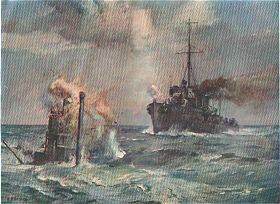
At War: A British Destroyer Ramming an Enemy Submarine by Bernard F Gribble. No text for this item |
A British Destroyer Engaging an Enemy Submarine by Bernard F Gribble. No text for this item |
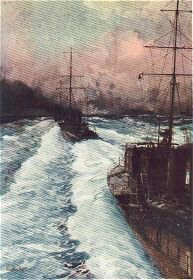
The Hornets of the Seas. Destroyers at Speed by Charles Dixon. No text for this item |
Battle Class Destroyers by Patrick Boniface. The Battle class was the epitome of wartime design with features developed through the struggles of world-wide conflict. In-depth research has allowed the author to cover the careers of each of the destroyers of the class. |
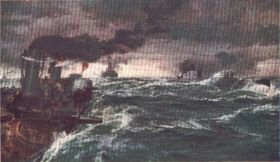
British Torpedo Boat Destroyers In Pursuit Of The German Torpedo Boats A2 and A6. With the A6 badly damaged and down by the stern, the Germans thought it wise to make for home. The Barbados had, however, got into touch by wireless with the destroyer Leonidas, who in turn summoned three of her sister craft. The two German torpedo boats soon saw four columns of smoke on the horizon, and they knew they were being pursued. Within an hour both vessels had met their fate, and were lying at the bottom of the sea. Forty-four of the total number of fifty-nine officers and men on board the Germans were picked up from the sea It then came to light that when the Columbia sank, one of her officers and two of her men were picked up and afterwards locked up by the Germans. Though the British saved forty-four of the Germans, the latter, utterly indifferent to the fate of the British sailors, left them to drown like rats in a trap. |
A British flotilla commanded by Captain Fox, sights a German flotilla steaming southwards. Accompanying the light cruiser Undaunted, which Captain Cecil Fox, who was in command of a flotilla, commanded were the destroyers Lance (Commander W de M Egerton) Lennox (Lieut Commander R Dane) Legion (Lieut-Commander Claud F Allsup) and Loyal (Lieut-Commander F Burges Watson) While steaming off the Dutch coast on October 17th 1914, the smoke of four vessels was seen to the north. Captain Fox at once ordered his vessels to clear for action and to give chase at full speed. On sighting them, the enemy turned and fled, and the British vessels dashed forward at over thirty miles an hour, washed from end to end by sea and spray. |
|
Contact Details |
|
Sign Up To Our Newsletter!
This website is owned by Cranston Fine Arts. Torwood House, Torwoodhill Road, Rhu, Helensburgh, Scotland, G848LE Contact: Tel: (+44) (0) 1436 820269. Email: cranstonorders -at- outlook.com
|
 |