|
|
|
|
|
|
|
|
|
UK Submarines Print List
Naval Art  Countries Royal Navy Ship Lists by Type Countries Royal Navy Ship Lists by Type  Submarines Submarines |
[UP] - Battleships - Aircraft Carriers - Cruisers - Submarines - Destroyers - Assault Ships - Auxiliaries - Submarine Depot Ships - Sailing Ships |
|
|
| Navigation | |
| Page 2 of 3 | Previous .. Page 2 .. Next |
|
|
|
|
|
|
|
|
|
|
|
|
|
|
|
|
|
|
|
|
|
| Navigation | |
| Page 2 of 3 | Previous .. Page 2 .. Next |
| Text for the above items : |
HMS Thunderbolt by Ivan Berryman. HMS Thunderbolt by Ivan Berryman. The submarine HMS Thunderbolt moves away from the depot ship Montcalm. Another submarine, HMS Swordfish is alongside for resupply. |
Dawn Departure by Robert Barbour. A freezing winter dawn breaks over the Gareloch as HMS Repulse heads out on another Atlantic Patrol. She is escorted as far as the deeper waters of the Firth of Clyde by assorted craft from Faslane base, including a Police launch and an inflatable. |
Tribute to Midget Submarine HMS XE-3 by Ivan Berryman. The midget submarine HMS XE-3 made a successful attack on the Japanese cruiser Takao in Johore Strait, Singapore on 31st July 1943. Having evaded anti-submarine defences to reach their target, the Commander Ian Fraser and his diver James Magennis are shown preparing to attach limpet mines to the cruiser. Fraser then managed with great skill to position the main explosives directly under the ship before retreating back through the defended waters to safety. Both were awarded the Victoria Cross for their actions that day. |
Swordfish Attack on U-652 by Jason Askew. (P) On 2nd June 1942 U-652 was scuttled after sustaining heavy damage from an attack by Swordfish aircraft. All the crew of the submarine were safe as she was sunk by torpedoes from U-81. |
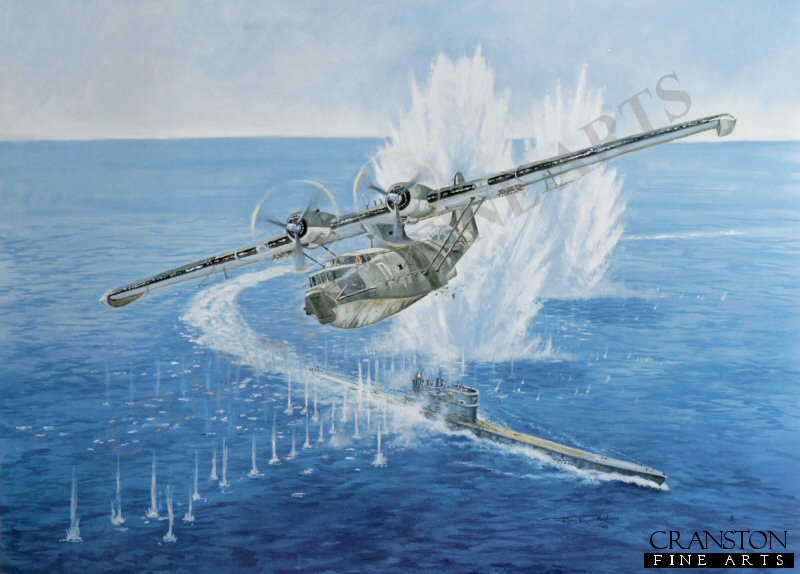
Catalina Attack by John Wynne Hopkins. D for Donald of 270 squadron, Royal Air Force, out of Freetown, West Africa operating in the Atlantic Ocean. It was during routine operation search that D for Donald surprised U515 on the surface and immediately attacked the submarine. U515 in putting up stiff resistance blew a large hole in the hull of D for Donald and the magazine of the starboard side 0.5 twin Browning was hit and the subsequent shrapnel wounded both blister gunners. U515 escaped but was sunk by an American naval hunter group a year later. D for Donald limped back to base and managed to make the beach before it would sink completely. |
HMS Torbay - Opration Flipper by Ivan Berryman. In foul weather off the coast of North Africa on the night of 14th November 1941, HMS Torbay deploys men of 11 (Scottish) Commando for an audacious attempt to assassinate German General Erwin Rommel. Named Operation Flipper, the attempt saw 26 men from HMS Torbay join just 8 more from HMS Talisman - the rest trapped aboard by the weather - land 250 miles behind enemy lines in Libya, and march to the headquarters for the attack late on 18th November. While the Commandos made it to the target building, their leader, Lt Col Geoffrey Keyes was killed and they discovered Rommel was not there. Retreating to the landing beach to be picked up by HMS Talisman, they were intercepted by Italian forces and captured facing impossible odds, although a few managed to scatter into the desert and escape. Keyes was posthumously awarded the Victoria Cross, HMS Torbay survived the war and was scrapped soon afterwards. |
A Submarine Taking a Rest by W L Wyllie. Two copies available |
Mission Completed by Robert Barbour. 7th June 1915. HM Submarine E.11 has just surfaced off Cape Helles at the entrance to the Dardanelles Straits. She has just safely negotiated passage through various minefields from the sea of marmora where she destroyed nine Turkish ships, and reached as far as Constantinople. In the background is the destroyer HMS Grampus and the beached freighter SS River Clyde. |
Working Up by Robert Barbour. T class submarine HMS Thorn surfaces during the work up exercises off the west coast of Scotland in late 1941. Taking part is an escort sloop of the Black Swan class and a Sunderland from 201 Squadron, RAF Coastal Command. |
HMS Sickle by Ivan Berryman. An S-Class submarine of the Royal Navy, HMS Sickle took part in operations in the Mediterranean in the Second World War after an uneventful first patrol off Norway. On the morning of 23rd of April 1943, five days into her second war patrol, HMS Sickle intercepted the Italian merchant Mauro Croce as it left Spanish waters from Valencia. Two torpedoes were fired but passed under the target. Immediately the submarine surfaced and, as seen in this painting, opened fire with the 76mm deck gun, scoring 15 hits from 19 rounds fired before the weapon jammed. HMS Sickle dived and broke off the action, but Italians later claimed three killed and four wounded in their complaint that the attack happened in Spanish territory. That May, HMS Sickle went on to attack German U-Boat U-755 unsuccessfully, but next day torpedoed and sank U-303. On her 11th war patrol in June 1944, HMS Sickle disappeared and is thought to have been lost to mines while returning to Malta. |
Surprise Attack by Ivan Berryman. The German crew of a Type VII U-boat man the guns as their submarine comes under a surprise attack from a Beaufighter of Coastal Command. |
HMS Trenchant by Ivan Berryman. Launched on 3rd November 1986 and commissioned into the Royal Navy on 14th January 1989, HMS Trenchant (S91) was the fifth of the Trafalgar class nuclear powered submarines and was the first Royal Navy vessel to fire the Block IV Tomahawk cruise missile. In addition to her complement of missiles, she is also equipped with Spearfish torpedoes and some of the most sophisticated data acquisition and underwater detection systems which allow her to monitor surface vessels undetected. |
HMS Vanguard in the Gareloch by Ivan Berryman. The lead ship of the Royal Navy's Vanguard Class SSBNs, HMS Vanguard (S28) was commissioned on 14th August 1993 and is based at HMNB Clyde at Faslane. |
Scapa Flow Graveyard by Robert Barbour. HM submarine H.28 enters Scapa Flow anchorage, passing the forlorn Battle Cruiser SMS Derfflinger and a group of sunken destroyers H.28 was one of the H class submarines. Launched in March 1918, she was finally scrapped in 1944. |
Good Morning, Spartan by Robert Barbour. Nimrod MR2P from 201 squadron based at RAF Kinloss, climbs away under full power during NATO exercises off the west coast of Scotland. The Nimrod has just completed simulated depth charge attacks on the fleet submarine HMS Spartan and is returning to Kinloss for breakfast. Spartan turns and heads for the Clyde Submarine Base at Faslane on the Gareloch. |
HMS Tireless by Ivan Berryman. Launched in March 1984 and commissioned into the Royal Navy in October the following year, HMS Tireless (S88) was the third of seven Trafalgar Class SSN submarines and is depicted in the Arctic waters near the polar ice cap in 1991. |
HMS Triumph by Ivan Berryman. Built in Barrow-in-Furness and the 7th and last of the Trafalgar class of British submarines, HMS Triumph is one of the most modern and potent vessels of her kind. Selected in March 2011 to take part in the coalition suppression of Colonel Gadaffi's attacks against his own people, HMS Triumph fired a number of TLAMs (Tomahawk Land Attack Missiles) aimed at air defence targets on the Libyan mainland at the outset of coalition operations, helping to reduce the threat of air attacks by the Libyan Air Force. |
HMS Sceptre by Ivan Berryman. Commissioned in 1943, HMS Sceptre was built by Scotts Shipbuilding in Greenock, Scotland. In a short career, Sceptre under the command of Lieutenant Ian McIntosh was involved with the X-Craft midget submarine attacks on German capital ships and floating docks in Norway. In addition, she sunk four enemy merchant ships and an enemy naval vessel between March and September 1944. HMS Sceptre was then refitted as a target submarine late in 1944, and was scrapped in 1949. |
HMS Trafalgar by Ivan Berryman. Launched on 1st July 1981, the SSN Fleet Submarine HMS Trafalgar (S107) entered service with the Royal Navy in May 1983 and enjoyed an active career until her retirement at the end of 2009 at her home base of HMNB Devonport, Plymouth. |
Sinking of U-Boat 347 by Tim Fisher. Flt. Lt. John Alexander Cruickshank in his consolidated Catalina. Winning his Victoria Cross for sinking U-347. |
HMS/M Thrasher by John Pettitt. HMS Thrasher was on her 8th patrol when on the 16th June 1942, an unsuccessful torpedo attack was made on the German merchant vessel Arkadia off Crete. Later, at 1155 hours, they spotted a deeply laden merchant vessel of about 3000 tons and turned to attack. The vessel had 5 escorts and aircraft circling overhead. At 1234 hours they fired the first salvo from 2000 yards, and immediately the submarine shook from a muffled explosion - probably a bomb from an aircraft, and machine gun bullets were heard striking the water above soon after. Three minutes later, two distant explosions were heard a few seconds apart - perhaps the torpedoes exploding or it may have been depth charges. Thrasher dived and at 1245 experienced the first of 33 depth charges, an uncomfortable experience with minor damage caused to the submarine. The following day, at 0150 hours, the crew discovered a large hole in the side of the gun platform and an unexploded bomb laying on the casing just forward of the gun. With a protion of its tail still attached, the bomb could not roll off of the casing. At 0240 hours, Thrasher went full astern and lowered into the water to dislodge the bomb. After, it was discovered that a further unexploded bomb was inside the casing and lying on the pressure hull. To remove this meant dragging the device 20 feet through the casing with great danger of it exploding. Lt P S W Roberts and PO T W Gould carried out this task and safely disposed of the bomb over the side at 0330 hours. For this action, they were both awarded the Victoria Cross. The painting depicts HMS Thrasher in her blue liver heading for Alexandria at the end of this patrol. |
|
Contact Details |
|
Sign Up To Our Newsletter!
This website is owned by Cranston Fine Arts. Torwood House, Torwoodhill Road, Rhu, Helensburgh, Scotland, G848LE Contact: Tel: (+44) (0) 1436 820269. Email: cranstonorders -at- outlook.com
|
 |