|
|
|
|
|
|
|
|
|
Flight Lieutenant James Pickering AFC Signed Naval Art
Naval Art  Signatures M to R Signatures M to R  Pickering, James Pickering, James |
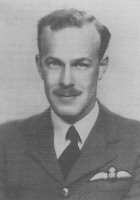
Flight Lieutenant James Pickering AFC
Jim Pickering joined the RAFVR in 1937, and was attached to 769 Sqn FAA, then 804 Sqn FAA. In June 1940 he returned to the RAF and flew Spitfires with 64 Sqn during the Battle of Britain. With 418 Flight Jim flew Hurricanes to Malta from HMS Argus on 2nd August 1940. This flight was to reinforce Maltas handful of outdated Gladiators and few surviving Hurricanes, and on 16th August was amalgamated to become 261 Squadron. With this unit Jim flew Hurricanes and at least five operations in the legendary Gladiators, which have been immortalised as Faith, Hope, and Charity. In April 1941 Jim was posted, first to Egypt, then 80 Squadron in October 1942, and 145 Squadron in December. He returned to the UK in 1943. Born in 1915 in Hinckley, Leicestershire, England, James Pickering studied the printing business in Europe during the 1930s. Convinced that Hitler represented a threat which could lead to war, Pickering joined the Royal Air Force Volunteer Reserve in 1937. As a 'week-end' flyer he earned his wings as a Sergeant Pilot in April of 1939. In September of that year Pickerings unit was mobilized. He was sent to an attachment of the Fleet Air Arm, where he flew Gladiators, Skuas, and Rocs, following his carrier training. In June of 1940 Pickering returned to the RAF flying Spitfires with No. 64 Squadron based in Kenley during the Battle of Britain. Pickering was selected along with eleven other carrier-qualified pilots to fly Hurricanes to Malta off the deck of the HMS Argus. On arrival in Malta these new Hurricanes and their pilots were integrated with the 3 flyable Gladiators and 3 Hurricanes already there to form No. 261 Squadron. This unit carried on the defense of Malta against Italian and German bombing missions which were launched regularly from Sicily, only sixty miles distant. Because of his earlier experience with the Gladiator, Pickering flew both Gladiators and Hurricanes at Malta for eight months. It is believed that Pickering is the last living RAF pilot to fly the Gladiator at Malta. Following his assignment in Malta, Pickering joined No. 1 Aircraft Delivery Unit which ferried aircraft from the West African Gold Coast and Port Sudan to various points throughout the war theater of operations. Pickering delivered a P-40 Warhawk to the Flying Tigers which involved one of the first flights 'over the hump.' In October of 1942 Pickering returned to operational flying with No. 80 Squadron (Hurricanes) at EI Alamein, and later with No. 145 Squadron (Spitfires). Having completed three separate operational tours, Pickering returned to England when victory was achieved in North Africa. In England, Pickering was assigned as a test pilot with No. 3501 Servicing Unit. He tested modifications to the Spitfire, and also test flew a number of P-51 Mustangs. Later he was transferred to No. 151 Repair Unit as its Chief Test Pilot. This was the largest unit of this kind in the RAF. Because of these experiences, Pickering is unusual in having flown eighty different types of aircraft during the War. Awarded the Air Force Cross, Pickering was released from the RAF at Wars end. He returned to his family-owned printing business, and spent his working career with the company, from which he retired in 1965. He also served as an outside Director of the largest Building Society in Britain. Pickering joined the Volunteer Reserve once again following the War, and continued to fly with the RAF until reaching the mandatory age limit of sixty. Pickering has had a private pilots license since 1938. He has flown thousands of hours and he is an expert on geological and archaeological research from the air. A Fellow of both the Geological Society and the Society of Antiquaries, Jim Pickering epitomizes the English character of determination and persistence which was so vastly underestimated by Hitler during WW2. He died on 6th October 2004.
| Flight Lieutenant James Pickering AFC - Signed Naval Art Naval Crew Signatures |
|
|
|
| Text for the above items : |
Clipped Signature - James Pickering. Flew Spitfires with No.64 Sqn during the Battle of Britain, then flew Hurricanes from HMS Argus to Malta to form No.261 Sqn, where he also flew the legendary Gladiators in defence of the island. He later flew Hurricanes and Spitfires in North Africa with No.80 and No.145 Sqn and remained a civilian pilot after the war. He died in 2004. Please note that this particular signature has been written in pen - not in pencil like most of our signatures. |
Faith Hope and Charity by Stan Stokes. With Italys entry into WW II on June 10, 1940, the epic two-and-one-half-year siege of Malta began. Symbolizing the defiant resistance of the people and defenders of that tiny island, the legend of Faith, Hope, and Charity grew from a handful of Gloster Sea Gladiators which initially comprised Maltas sole aerial defense. Until the arrival of the more modern Hawker Hurricanes, these obsolescent biplanes fought the Regia Aeronautica alone in the skies above Malta. Only six or seven Gladiators were assembled from the shipment of eighteen crated aircraft which had been delivered by the HMS Glorious. Others were utilized for spare parts, and three had been dispatched, still crated, to Egypt. Though hugely outnumbered, the defenders fought on, raising the morale of the citizens of Malta, and denying the Italians mastery of the sky. Suffering from a constant shortage of spare parts, tools and equipment, the devoted ground support crews were never able to keep more than three Gladiators operational at any point in time. Only one of these Gladiators was totally lost in aerial combat, and the sole surviving aircraft was presented to the people of Malta, and today stands in their National War Museum as a proud symbol of courage and endurance. In Stan Stokes painting, a Sea Gladiator, piloted by Flight Lt. James Pickering, tangles with a Fiat C.R. 42 over Malta in 1940 while an Italian Savoia S.79 tri-engined bomber passes by in the background. The Gloster Gladiator represented the zenith of development of the classic biplane fighter aircraft, a design formula which characterized an entire era from WW I until the advent of the monoplane fighter just before WW II. Glosters naval model of the Gladiator was equipped with a Bristol Mercury VIIIA engine providing a maximum speed of 253 MPH, a rate of climb of 2300 feet per minute, an operational ceiling of 32,200 feet, and a range of 415 miles. The Gladiator was armed with four .303 inch Browning machine guns, and incorporated several advanced features including an enclosed cockpit and wing flaps. One top RAF ace, Sqd. Ldr. Pattle, attained eleven victories flying the Gladiator. A total of 527 Gladiators were produced, and the aircraft served in twelve different countries. The Italians were overly persistent in their emphasis on biplane fighters, stemming from their successes with these highly maneuverable machines during the Spanish Civil War. Employing distinctive Warren-truss type interplane bracing the C.R. 42 was powered by a Fiat A74 R.C. 38 engine providing a maximum speed of 274 MPH and a range of 485 miles. The C.R. 42 was more lightly armed than the Gladiators it opposed, possessing only two 12.7mm Breda machine guns. The C.R 42 served on all of Italys fronts including North and East Africa, France, Britain, the Balkans, and Russia. Exported to Hungary, Sweden and Belgium, the C.R. 42 ironically served alongside the Gladiator in other theaters of operation during WW II. |
George Cross Island Association 60th Anniversary Limited Edition Print by John Young. Official limited edition print of the 60th Anniversary of the George Cross Island Association. Spitfires from one of Maltas most famous squadrons, 249, climbing up over Valetta harbour in the summer of 1942. The panorama beneath the aircraft is the city with its thousands of Maltese citizens daily exposed to the enemy blitz, ships of the Royal Navy and Merchant Service, and the Armys anti-aircraft batteries. |
|
Contact Details |
|
Sign Up To Our Newsletter!
This website is owned by Cranston Fine Arts. Torwood House, Torwoodhill Road, Rhu, Helensburgh, Scotland, G848LE Contact: Tel: (+44) (0) 1436 820269. Email: cranstonorders -at- outlook.com
|
 |




